Author: Sister Bridget Corfield

  • Old Superstitions That Still Comfort People Today

    Old Superstitions That Still Comfort People Today

    Old Superstitions That Still Comfort People Today

    Long before self-help books, motivational podcasts, and endless social media advice, people turned to smaller things for comfort.

    A pinch of salt tossed over the shoulder.
    A wish made on the first evening star.
    Knocking on wood after speaking too confidently about the future.
    Keeping a lucky coin tucked away in a pocket or purse.

    Superstitions have existed in nearly every culture throughout human history. Some were meant to protect against bad luck. Others invited blessings, prosperity, love, or safety. Many began in times when life felt uncertain and frightening, giving people small rituals that made the world feel a little less chaotic.

    And even now, in the middle of modern life with smartphones and streaming services and grocery pickup apps, many of those old habits still remain.

    Not because people are foolish.

    Because human beings have always searched for comfort, meaning, and reassurance.

    One of the oldest and most widespread superstitions involves throwing spilled salt over the left shoulder. In many traditions, salt was seen as protective and purifying. Spilling it was considered unlucky, and tossing a pinch behind you was believed to ward off negativity or bad fortune lurking nearby.

    Even people who laugh while doing it often still do it anyway.

    Just in case.

    Knocking on wood is another superstition that has survived centuries. Historians believe it may trace back to ancient beliefs that spirits lived within trees. Touching wood after speaking of good fortune was thought to prevent jealousy from spirits or fate itself.

    Today, people still instinctively rap their knuckles against a table after saying things like:
    “I haven’t been sick all year.”
    “My car has been running perfectly.”
    “Things are finally calming down.”

    It is part habit.
    Part humor.
    Part tiny prayer hidden inside ordinary conversation.

    Wishing on stars also continues to comfort people in quiet ways. There is something deeply human about looking up into the night sky and attaching hope to a distant point of light. For centuries, people believed stars carried spiritual significance and that wishes spoken beneath them traveled farther into the unseen world.

    Even now, adults who insist they “do not believe in that stuff” still sometimes pause when they see a shooting star.

    And for one small moment, they hope.

    Many superstitions center around protection of the home.

    Horseshoes above doorways.
    Brooms placed near entrances.
    Salt across thresholds.
    Protective herbs hanging in kitchens.
    Keeping windows cracked during funerals so spirits could leave peacefully.

    These traditions often blurred the line between spirituality, folklore, and practical comfort. A protected home felt safer emotionally as well as spiritually.

    Some superstitions revolve around animals.

    Black cats remain one of the most famous examples. Depending on the culture, they were seen either as omens of bad luck or symbols of protection and magic. Crows and ravens were associated with prophecy, wisdom, or messages from the spirit world. Crickets inside the home were sometimes considered signs of good fortune.

    Birds at windows still unsettle many people today, especially after loss or during periods of emotional upheaval.

    Then there are the deeply personal superstitions people create for themselves over time.

    A “lucky” sweater worn during difficult situations.
    A certain song that always seems to play before good news.
    A necklace worn for comfort.
    A routine repeated before traveling.
    A candle lit during stressful times.

    These small rituals become emotional anchors.

    And perhaps that is why old superstitions endure even in modern times. Beneath the folklore and symbolism, many of them offer something people desperately need:
    A sense of control.
    A sense of connection.
    A sense that the world may contain hidden meaning after all.

    Superstitions also connect us to the generations that came before us.

    A grandmother teaching a child never to open an umbrella indoors.
    A parent quietly making the sign of the cross while driving through storms.
    A family repeating the same New Year traditions decade after decade.

    These small acts become threads stretching across time.

    Not every superstition needs to be taken literally to hold value.

    Sometimes the comfort itself is the magic.

    Sometimes the ritual matters more than whether the universe truly keeps score of spilled salt and broken mirrors.

    And in uncertain times especially, people often return instinctively to small comforting traditions that make life feel warmer, safer, and more connected.

    A candle in the window.
    A wish whispered into darkness.
    A lucky charm tucked into a pocket.
    Knuckles tapping softly against wood after speaking hope out loud.

    Tiny rituals.

    Tiny comforts.

    Tiny ways human beings remind themselves that perhaps the world still holds a little mystery after all.

    In Service,

    Sister Bridget

    spellmaker.com

  • The Difference Between Anxiety and Intuition

    The Difference Between Anxiety and Intuition

    The Difference Between Anxiety and Intuition

    One of the most common spiritual struggles people face is learning the difference between anxiety and intuition.

    At first glance, the two can feel surprisingly similar.

    Both create strong feelings. Both can arrive suddenly. Both can make your attention lock onto a person, situation, or decision until it becomes difficult to think about anything else.

    But anxiety and intuition are not the same thing at all.

    Learning to recognize the difference can bring enormous peace, especially for sensitive people who tend to absorb emotional energy very deeply.

    Anxiety is loud.

    Intuition is quiet.

    That is often the simplest way to begin understanding the difference.

    Anxiety tends to spiral. It repeats itself endlessly like a smoke alarm with dying batteries. It demands immediate action. It pushes urgency, fear, worst-case scenarios, and constant over-analysis.

    “What if something terrible happens?”
    “What if I made the wrong choice?”
    “What if they leave?”
    “What if I fail?”
    “What if I missed a sign?”

    Anxiety rarely brings clarity. Instead, it creates loops. The mind races in circles searching for certainty that never fully arrives.

    Intuition feels very different.

    Intuition is usually calm, direct, and surprisingly simple. It often arrives as a brief inner knowing before fear has time to interrupt it. Sometimes it is only a quiet feeling in the body. A pause. A pull. A sense that something is either right or wrong without being able to fully explain why.

    Unlike anxiety, intuition does not usually scream.

    It nudges.

    Anxiety often feels frantic in the body as well. Tight chest. Racing thoughts. Restlessness. Compulsive checking. Difficulty relaxing. It feeds on repetition and tends to grow louder the more attention you give it.

    Intuition usually feels steadier.

    Even when intuition warns us about something difficult, it often carries a strange sense of clarity beneath it. The message itself may not be pleasant, but it does not feel chaotic. There is less emotional static attached to it.

    For example, anxiety may say:
    “They hate me. Something is wrong. I need to text again right now.”

    Intuition may quietly say:
    “This situation feels unhealthy for me.”

    One spirals outward endlessly.

    The other simply knows.

    Another important difference is that anxiety is often rooted in fear of the future, while intuition exists very much in the present moment.

    Anxiety tries to predict and control every possible outcome. It wants guarantees. It wants certainty. It wants absolute reassurance before allowing you to rest.

    Intuition does not usually explain itself that thoroughly.

    Sometimes intuition simply says:
    “Do not go there.”
    “Call this person.”
    “Wait.”
    “Pay attention.”
    “Something feels off.”

    And then it becomes quiet again.

    Many people struggle with intuition because they keep waiting for it to sound dramatic. They expect thunderbolts, visions, or unmistakable signs. But intuition is often subtle. The first whisper is usually the clearest one before fear and overthinking rush in to bury it under mental noise.

    Modern life makes this even harder.

    People today are overstimulated constantly. Phones buzzing. News alerts. Endless scrolling. Stress. Financial pressure. Emotional exhaustion. The nervous system rarely gets a chance to settle long enough for intuition to rise clearly to the surface.

    When people are overwhelmed, anxiety can begin impersonating intuition.

    That is why grounding matters so much.

    Rest matters.
    Sleep matters.
    Silence matters.
    Stepping away from constant noise matters.

    A frightened nervous system cannot always interpret spiritual or emotional signals clearly.

    One helpful exercise is to pause and ask yourself:
    “Does this feeling bring clarity or confusion?”

    Anxiety usually creates confusion.

    Intuition usually creates clarity, even if the answer is uncomfortable.

    Another helpful question is:
    “Is this feeling growing louder because I keep feeding it?”

    Anxiety feeds on attention. The more we check, analyze, panic, and seek reassurance, the larger it becomes.

    Intuition does not usually demand obsession.

    It simply remains present until acknowledged.

    This does not mean intuition is always perfect or that anxiety should be ignored completely. Anxiety can sometimes alert us that something in our lives genuinely needs care or attention. But living in a constant state of fear makes it difficult to hear our deeper inner wisdom clearly.

    Part of spiritual growth is learning how to become still enough to recognize your own inner voice again.

    That takes patience.

    And gentleness.

    Not every fearful thought is a prophecy.
    Not every coincidence is a sign.
    Not every feeling deserves immediate action.

    Sometimes the most spiritual thing a person can do is pause, breathe, ground themselves, and listen carefully before reacting.

    Intuition tends to arrive quietly.

    Fear tends to pound on the door.

    Learning the difference between the two can change your entire relationship with yourself.

    In Service,

    Sister Bridget

    spellmaker.com
  • The Legend of the Crimson Witch of New Orleans

    The Legend of the Crimson Witch of New Orleans

    The Legend of the Crimson Witch of New Orleans

    In the older parts of New Orleans, where iron balconies cast long shadows across narrow streets and the air still carries the memory of candle smoke and river water, there are stories that never fully disappear.

    They survive quietly.

    In family recollections.
    In passing conversation.
    In the way certain names are spoken softly, as though they still belong to the city itself.

    One of those stories is about a woman known as the Crimson Witch.

    No one agrees on her real name. Some said she was French. Others believed she was Creole. A few insisted she came from somewhere else entirely and simply chose to remain in New Orleans after tragedy changed the course of her life.

    But while the details shifted over time, one thing remained consistent:

    People came to her for matters of the heart.

    Not in crowds or spectacle, but quietly, often in the evening after the streets had settled and the city softened into lamplight and music drifting through open windows.

    They came with ordinary heartbreaks.
    Distance in a marriage.
    Love that had cooled.
    Loneliness.
    Fear of never being chosen.
    Relationships strained by misunderstandings and silence.

    And according to the stories that survived, the Crimson Witch approached these situations differently than many others of her time.

    She did not promise domination or control.

    She did not claim to force love where none could exist.

    Instead, her work focused on gentleness.

    On softening tension.
    On encouraging affection.
    On clearing bitterness and allowing warmth to return where it had faded beneath hurt and exhaustion.

    That distinction became the heart of her reputation.

    Those who sought her out described her as patient and kind. She listened carefully before offering guidance. Her work centered around candles, oils, herbs, and quiet rituals meant to support connection rather than overpower it.

    In modern terms, her approach might seem subtle.

    At the time, it was simply understood as effective.

    People returned to her not because they feared her, but because they felt calmer after leaving her home. Supported. Hopeful again.

    And often, the changes came gradually.

    A long-delayed conversation finally happened.
    A partner softened emotionally.
    A relationship that had grown cold slowly began warming again.

    Not dramatic miracles.

    Small human shifts that mattered deeply to the people living through them.

    Over time, the story of the Crimson Witch became woven into the folklore of New Orleans itself. Though no formal records remain, elements of her methods continued quietly through generations. The belief that love responds better to care than force became part of the legacy associated with her name.

    There is also a sadness woven through the legend.

    Many versions of the story claim the Crimson Witch herself lost the great love of her life unexpectedly when she was still young. Some say he died in an accident near the river. Others say illness took him before they could marry.

    Whether true or embroidered over time, the detail explains the tenderness associated with her work.

    There is no bitterness in the stories about her.
    No cruelty.
    No hunger for power.

    Only the sense of a woman who understood how fragile love could be and chose to help protect it where she could.

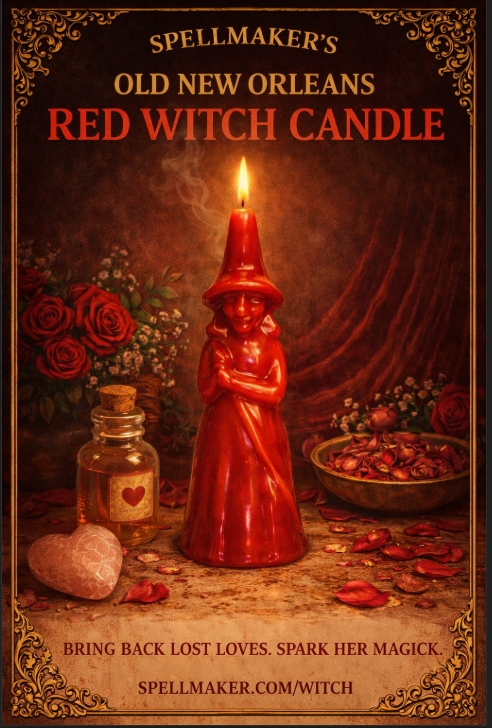
    That legend became the inspiration for our Red Witch Candle.

    Created in honor of the Crimson Witch and the gentle style of love magic associated with her story, each Red Witch Candle is hand poured with care. The original mold itself was hand made by Parran Matt, giving the candle a unique connection to old-world craftsmanship and tradition.

    The Red Witch Candle is intended for warmth, attraction, emotional closeness, reconciliation, and encouraging affection to grow naturally. Many people use it for rekindling existing relationships, while others burn it to draw new love into their lives in a softer, more organic way.

    Like the woman who inspired it, the candle is not about force.

    It is about invitation.

    About creating space for love to breathe again.

    Perhaps that is why the story of the Crimson Witch continues to endure while so many others fade away.

    Because beneath the folklore, beneath the candlelight and whispered stories, there remains something deeply human at its center:

    The hope that love, when treated gently, can still find its way home.

    In Service,

    Sister Bridget

    spellmaker.com
  • Simple Exercises to Strengthen Your Intuition

    Simple Exercises to Strengthen Your Intuition

    Simple Exercises to Strengthen Your Intuition

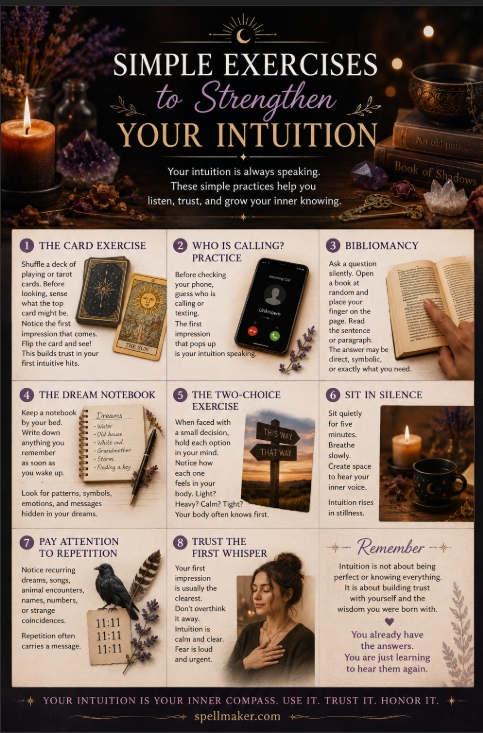
    Intuition is a little like a muscle. The more you use it, the easier it becomes to recognize its voice.

    The problem is that most people spend years talking themselves out of their instincts. They second-guess themselves, dismiss feelings as “silly,” or ignore the quiet inner nudges that do not seem logical enough to trust.

    But intuition rarely arrives as a booming announcement.

    More often, it slips in softly. A feeling. A hesitation. A sudden certainty. A tiny inner whisper saying, “Pay attention.”

    The good news is that intuition can absolutely be strengthened through practice. You do not need special gifts, expensive tools, or complicated rituals to begin. In fact, some of the best exercises are simple enough to fit into everyday life.

    The Card Exercise

    Take a deck of playing cards or tarot cards and shuffle them well.

    Before turning over the top card, pause for a moment and try to feel what is there. Do not overthink it. Notice the first impression that comes to mind:

    • red or black
    • major or minor arcana
    • hearts or spades
    • masculine or feminine energy
    • fast or slow feeling

    Then flip the card over and see what you got right.

    This exercise is not about perfection. It is about learning the feeling of intuition before the logical mind barges in wearing muddy boots and shouting opinions.

    The “Who Is Calling?” Practice

    Before checking your phone when it rings or buzzes, stop for one second and guess who it is.

    Again, do not force it. Let the first impression rise naturally.

    Most people are surprised how often they begin getting little hits once they start paying attention.

    Bibliomancy

    This is an old divination method that is beautifully simple.

    Take a favorite spiritual book, poetry collection, Bible, folklore book, or even a beloved novel. Quiet your mind, ask a question silently, then open the book at random and place your finger somewhere on the page.

    Read the sentence or paragraph.

    Sometimes the answer is startlingly direct. Sometimes symbolic. Sometimes oddly comforting in exactly the right way.

    The Dream Notebook

    Dreams are one of the oldest roads into intuition.

    Keep a notebook beside your bed and write down anything you remember immediately upon waking, even fragments:

    • colors
    • people
    • symbols
    • emotions
    • repeating locations
    • unusual animals
    • phrases

    Over time, patterns often emerge. Certain symbols may become deeply personal to you. Water may always appear before emotional events. Roads may show up during periods of transition. Specific people may repeatedly appear as messengers or warnings.

    The act of recording dreams also signals to the subconscious that you are listening.

    The Two-Choice Exercise

    When faced with a small decision, pause before choosing.

    For example:

    • Which route should I drive?
    • Which book should I read next?
    • Which candle should I light tonight?
    • Which email should I answer first?

    Hold one option in your mind, then the other.

    Notice how each one feels in your body. Light? Heavy? Calm? Tight? Open? Resistant?

    Intuition often speaks through physical sensation before words.

    Sit in Silence for Five Minutes

    This sounds deceptively easy.

    Most people are so surrounded by noise that they rarely hear their own inner voice anymore. Phones buzz. Videos autoplay. Thoughts race constantly like raccoons fighting in a dumpster behind the mind.

    Five quiet minutes can feel strangely uncomfortable at first.

    But silence creates space for intuition to rise.

    Light a candle if you wish. Sit comfortably. Breathe slowly. Do not demand messages or visions. Simply become still enough to notice what naturally surfaces.

    Pay Attention to Repetition

    One of the strongest intuition exercises is simply observing your own life more carefully.

    Notice:

    • recurring dreams
    • repeating songs
    • certain animals appearing frequently
    • names that keep surfacing
    • strange coincidences
    • sudden emotional pulls toward places, objects, or people

    The goal is not paranoia or obsession. Not every bird is a prophecy from the universe. Sometimes a crow is simply a crow being gloriously loud and judgmental from a fence post.

    But repetition often carries meaning.

    Trust the First Whisper

    One of the biggest intuition killers is over-analysis.

    Many people receive an intuitive impression immediately, then spend the next twenty minutes arguing with themselves until the original feeling disappears under a pile of mental paperwork.

    Practice honoring the first whisper.

    Not every feeling will be correct. That is normal. Intuition develops through use, patience, and discernment over time.

    The important thing is learning to recognize the difference between genuine inner knowing and fear-driven spiraling.

    Intuition usually feels calm and clear.

    Fear usually feels loud and urgent.

    Final Thoughts

    Strengthening intuition is less about becoming “psychic” and more about rebuilding trust with yourself.

    Your inner voice has likely been speaking your entire life.

    The real practice is learning how to hear it again.

    In Service,

    Sister Bridget

    spellmaker.com
  • Happy Mother’s Day, Mambo Sam!

    Happy Mother’s Day, Mambo Sam!

    Mother’s Day feels a little different when your mother is also your teacher, your business partner, your spiritual guide, and sometimes the person reminding you at 11 PM that you forgot to answer an email.

    For many of you, Mambo Samantha has been part of your lives for years through readings, candles, classes, prayers, Sacred Circles, books, and long conversations during difficult moments. But to us, she is also simply “Sam.” The person who built Spellmaker through decades of hard work, faith, stubborn determination, and a genuine desire to help people find hope when life feels heavy.

    Spellmaker did not appear overnight from an influencer trend or a viral video. It was built one candle, one prayer, one package, and one client at a time. Long before social media existed, Mambo Sam was answering letters, teaching classes, studying, praying, lighting candles, writing lessons, and trying to create a place where spirituality felt approachable instead of frightening or fake.

    One of the things people often notice when they speak with her is that she does not promise impossible things. She has never believed in frightening people into spending money or making wild guarantees. Her approach has always been rooted in honesty, compassion, tradition, and the understanding that real spiritual work walks hand in hand with real life.

    That spirit shaped Spellmaker from the beginning.

    Over the years, we have heard from people going through heartbreak, grief, illness, loneliness, fear, uncertainty, financial struggles, and moments where they simply needed someone to listen. Some came looking for candles or oils and stayed because they felt seen. Others arrived curious about spirituality and found a community instead.

    Behind the scenes, Mambo Sam has spent countless hours helping people through some of the hardest moments of their lives while also being a mother, caretaker, teacher, writer, and business owner. None of that work is glamorous. Most of it happens quietly. Answering messages late at night. Checking on clients. Castings. Readings. Teaching students. Planning rituals.

    Encouraging people who have nearly lost hope.

    That is the side of spiritual work many people never see.

    Motherhood itself carries a kind of sacred strength. It is protection, endurance, wisdom, sacrifice, patience, fierce love, and the ability to keep going even when exhausted. In many ways, those same qualities shaped the heart of Spellmaker over the past thirty years.

    This Mother’s Day, we wanted to pause for a moment and simply say thank you to Mambo Sam for the work she has done, the people she has helped, and the community she has helped build through kindness, honesty, and faith.

    And to all of the mothers, grandmothers, stepmothers, spiritual mothers, caregivers, and nurturing souls in our community, we celebrate you as well. The world is held together more often by quiet acts of love than grand gestures, and many of those acts begin with women who continue showing up for others day after day.

    Happy Mother’s Day from all of us at Spellmaker.

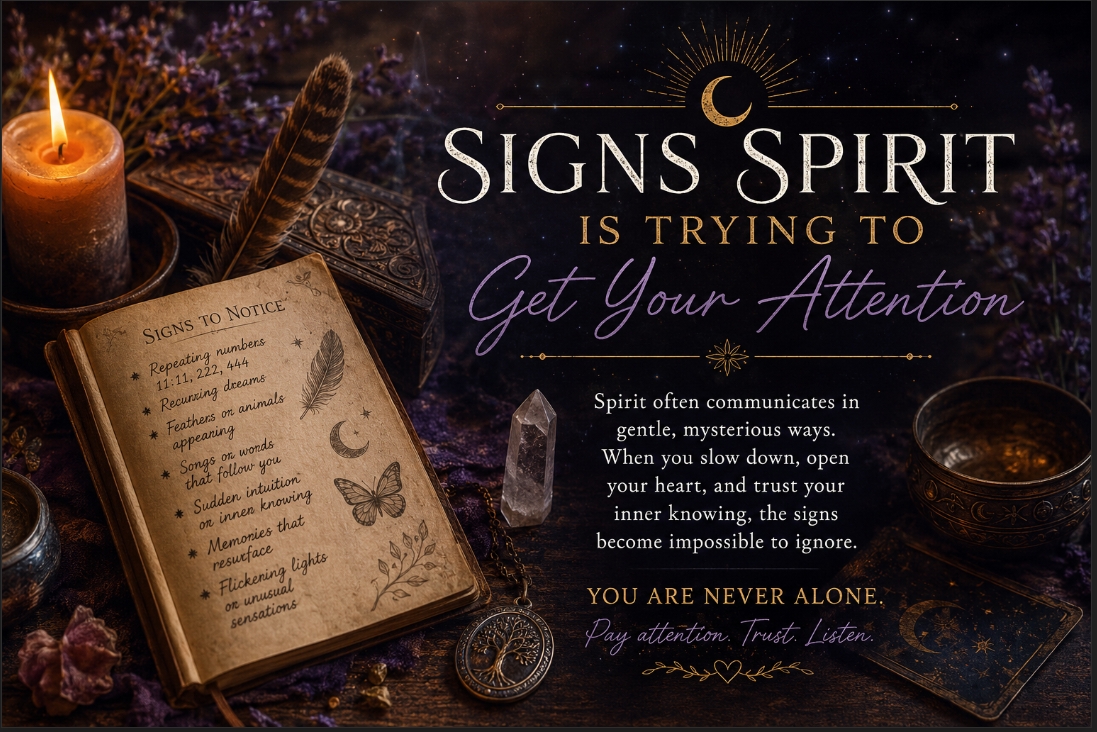
  • Signs Spirit Is Trying to Get Your Attention

    Signs Spirit Is Trying to Get Your Attention

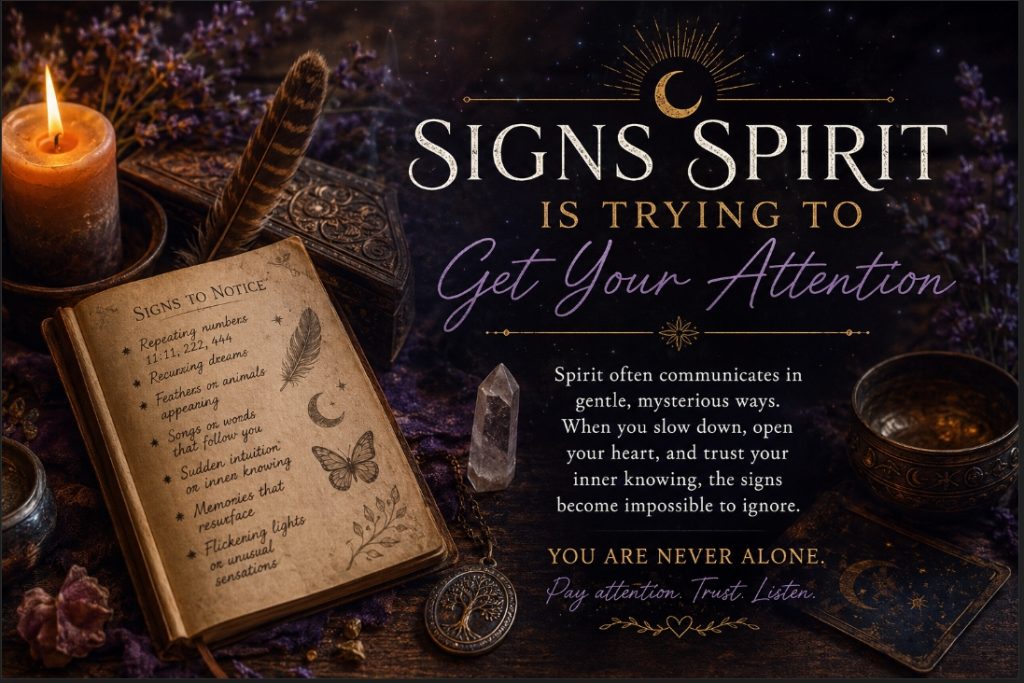
    Have you ever had one of those strange stretches of time where the same thing keeps happening over and over again? The same song follows you from place to place. A certain name appears everywhere you look. You dream vividly about someone you have not thought about in years. A feather lands at your feet at exactly the moment you are praying for guidance.

    Most of us have experienced moments like this, even if we are hesitant to talk about them out loud.

    In many spiritual traditions, these little moments are seen as signs that spirit is trying to get your attention. Not always in some dramatic movie-style way with thunder and glowing lights, but quietly. Repeatedly. Gently tapping at the edge of your awareness until you finally stop long enough to notice.

    The truth is, spirit often speaks softly.

    Sometimes the signs are comforting. Sometimes they are warnings. Sometimes they are simply reminders that you are not alone.

    One of the most common ways spirit communicates is through repetition. If something keeps appearing again and again, pay attention. Repeating numbers, recurring symbols, hearing the same unusual phrase multiple times in one day, or constantly crossing paths with the same type of animal can all carry meaning. The important thing is not only what appears, but how it makes you feel. Spirit communication often carries a certain emotional weight to it. Something inside you pauses and says, “Wait a minute…”

    Dreams are another powerful doorway.

    Many people receive spiritual messages while sleeping because the mind is quieter and less guarded. You may dream of loved ones who have crossed over, old homes, water, roads, babies, storms, or unfamiliar places that somehow feel deeply important. Some dreams fade quickly. Others cling to you all day like cobwebs in the mind. Those lingering dreams are often the ones worth exploring more carefully.

    Animals have long been connected with spiritual symbolism as well. A hawk circling overhead during a difficult decision. A butterfly appearing after the loss of a loved one. A crow calling loudly outside your window when you have been asking for clarity. Different traditions interpret these encounters differently, but many people instinctively feel when an animal encounter carries unusual significance.

    Then there are the moments that cannot easily be explained at all.

    You think about someone moments before they call. You suddenly feel strongly urged not to take a certain road. You walk into a room and feel the energy shift immediately. A memory surfaces out of nowhere and later proves important. These experiences often arrive quietly and disappear quickly if ignored.

    Modern life trains people to dismiss their intuition constantly. We are taught to explain everything away, rush past our instincts, and second-guess ourselves at every turn. But intuition is one of the oldest spiritual languages there is.

    That does not mean every flickering lightbulb is a ghost or every coincidence is destiny. Sometimes a cigar is just a cigar, and sometimes the smoke detector simply needs batteries. Good spiritual practice requires balance, grounding, and common sense alongside intuition.

    Still, there are moments that reach beyond coincidence.

    Usually, spirit signs become stronger when we are standing at crossroads in life. During grief. During heartbreak. During major transitions. During periods where we feel lost, lonely, exhausted, or uncertain about the future. It is almost as if the spiritual world leans closer during those vulnerable moments, trying to remind us that we are still connected to something larger than ourselves.

    The hardest part is often slowing down enough to notice.

    Spirit rarely competes with noise. It tends to arrive in stillness. In the quiet drive home. In the few minutes before sleep. In the early morning hours when the world is soft and half-awake. Sometimes the signs have been there all along, waiting for us to become calm enough to see them.

    If you feel spirit may be trying to reach you, begin simply.

    Keep a small notebook beside your bed for dreams and unusual experiences. Pay attention to repeated patterns. Spend a few moments in silence each day. Light a candle and pray in your own words. Ask sincerely for clarity, wisdom, and protection. You do not need elaborate rituals to begin strengthening your spiritual awareness. Often, openness and honesty matter far more than perfection.

    And perhaps most importantly, trust your own inner knowing.

    Deep down, most people can tell the difference between random noise and a moment that carries meaning. Spirit communication often arrives with a feeling that is difficult to describe but impossible to ignore. A hush. A pull. A sudden certainty that something important is brushing against the edges of your life.

    The world is far more mysterious than most people allow themselves to believe.

    Sometimes spirit whispers.

    Sometimes it knocks.

    And sometimes it keeps placing the same sign directly in your path until you finally stop and listen.

    In Service,

    Sister Bridget

    spellmaker.com
  • The Beltane Fire!

    The Beltane Fire!

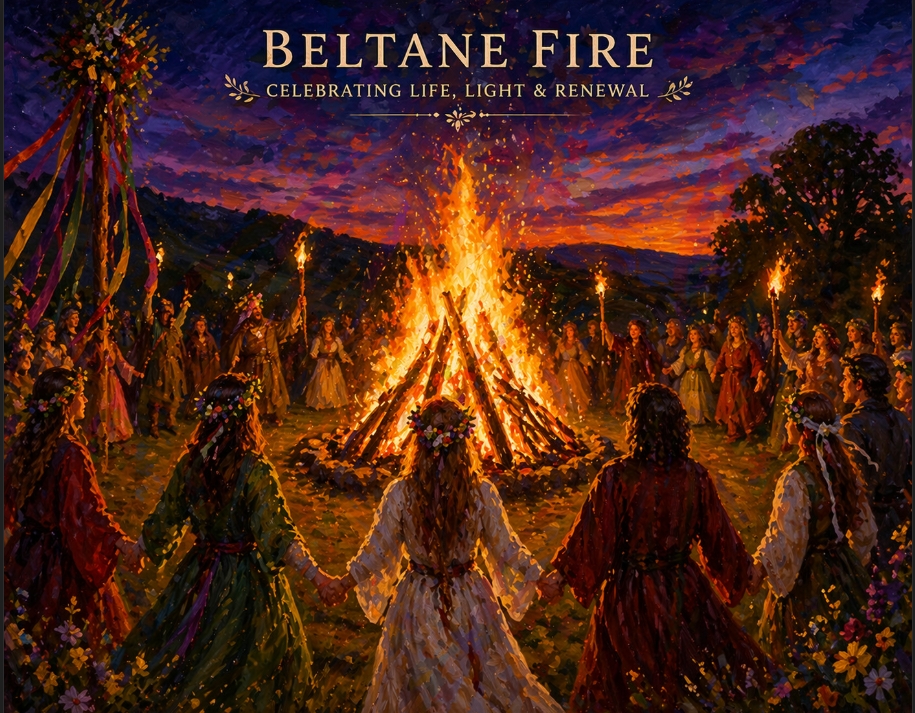
    At the center of Beltane, there is fire.

    Not as decoration, not as an afterthought, but as the heart of the celebration. Long before modern rituals and interpretations, people gathered around a single flame to mark the turning of the season. It was practical, yes, but it was also deeply meaningful. That fire represented the shift into the growing half of the year, when life moved outward again and the land came fully alive.

    In many traditions, all household fires were extinguished before Beltane began. Homes went dark, at least for a time, creating a pause between what had been and what was about to begin. Then a large communal fire was lit, often on a hill or in a place that could be seen from across the land. From that one flame, people would relight their hearth fires and carry them back home.

    There is something powerful in that image.

    Instead of each household starting on its own, the entire community drew from the same source. It was a shared beginning, a way of stepping into the new season together. The fire was not just warmth and light. It was continuity, connection, and a reminder that life moves in cycles rather than clean breaks.

    The Beltane fire was also protective.

    Cattle, which were essential for survival, were often driven between two fires as they were led out to summer pasture. The heat and smoke were believed to cleanse them and guard against illness or misfortune. People would pass through the smoke as well, letting it drift over them as a form of blessing. It was a simple act, but one that carried a deep sense of care and intention.

    In some places, the fire itself was made in a very specific way. A “need-fire” would be kindled from scratch, often by friction, rather than taken from an existing flame. This made the fire feel new, as though it had been born for that moment. It added another layer to the idea of renewal, not starting over, but strengthening what was already there with fresh energy.

    Even now, the meaning of the Beltane fire holds.

    You don’t need a hilltop bonfire or a village gathering for it to matter. Lighting a candle is enough. Sitting with that small flame, even for a minute, connects you to the same rhythm. It marks the return of warmth, the movement of life, and the quiet understanding that you are stepping into a new phase of the year.

    The fire doesn’t ask for anything complicated.

    It simply burns, steady and present, offering light, warmth, and a place to begin again.

    In Service,

    Sister Bridget

  • Gran Bwa and Beltane!

    Gran Bwa and Beltane!

    Beltane is the point in the year when everything is in motion. The ground has warmed, the trees have filled out, and what felt quiet not long ago is now active and visible. It’s easy to focus on the surface of that. Flowers opening, air softening, that sense that life is finally back.

    But that visible growth doesn’t happen on its own. There is something underneath it that holds it steady.

    That’s where Gran Bwa comes in.

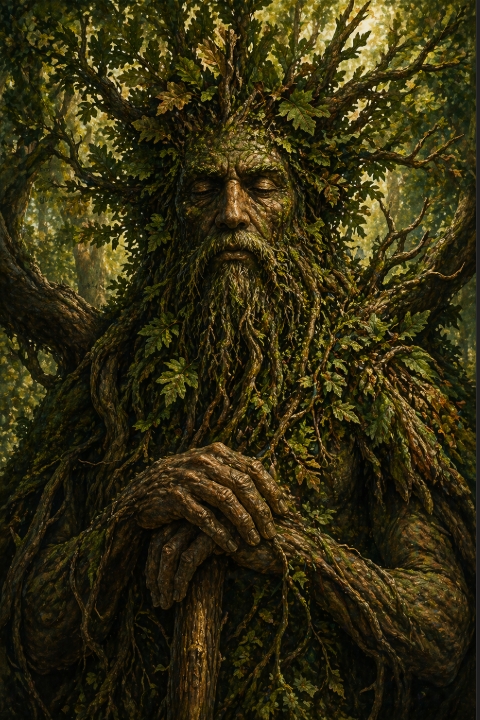
    Gran Bwa is not a seasonal figure and not a symbol. He is a lwa of the forest, rooted in the deep places where growth begins and is sustained. He is tied to the trees, the earth, and the structure of the natural world itself. Not just the beauty of it, but the order of it. The part that keeps everything from collapsing under its own weight.

    At Beltane, when everything feels like it’s expanding outward, it helps to remember that growth always has a foundation. Roots go down as branches go up. The land doesn’t just bloom. It holds.

    That’s the difference Gran Bwa brings into the season.

    He is not rushed. He is not flashy. He does not respond to force or impatience. He responds to respect, to steadiness, to a clear understanding of where you stand. When things begin to move quickly, his presence brings them back into balance.

    This is especially important at Beltane, because the energy of the season can make people want everything to happen at once. To grow faster, to open wider, to push things forward before they’re ready.

    Gran Bwa does not move that way.

    He supports what is rooted. He strengthens what already has structure. He works with what belongs, not with what is being forced into place.

    So during this season, it can help to shift your focus slightly. Not just on what you want to grow, but on what supports that growth.

    Look at what is already steady in your life. Look at what has a foundation, even if it’s small. Look at what you are building from, instead of trying to build from nothing.

    Those are the places where real movement happens.

    Beltane brings the energy to grow, but Gran Bwa reminds you how to hold it, how to respect it, and how to let it build in a way that lasts.

    In Service,

    Sister Bridget

  • The Maypole Tarot Spread (Beltane)

    The Maypole Tarot Spread (Beltane)

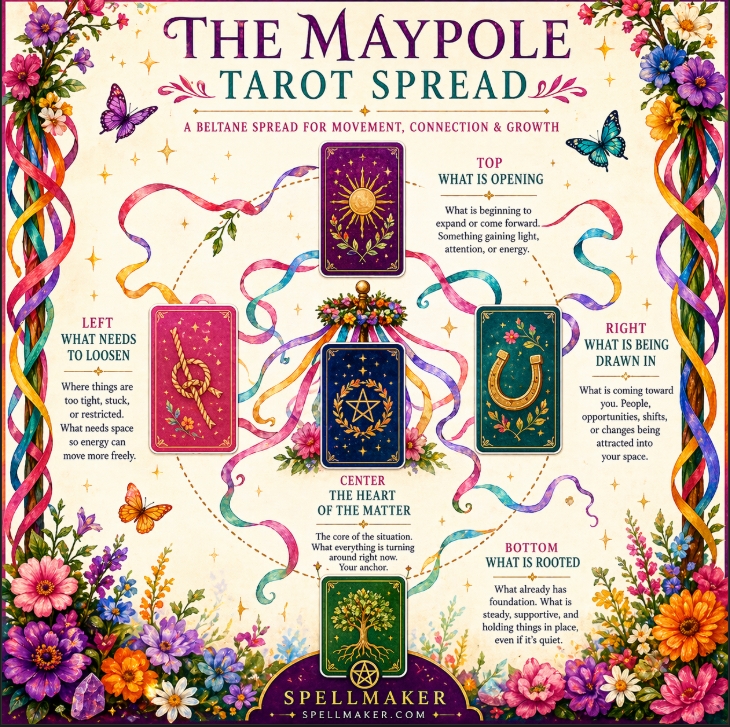
    The Maypole is all about movement around a center.

    Ribbons weaving in and out, crossing, circling, building something through motion instead of straight lines. That’s what Beltane energy feels like. Things aren’t just starting. They’re interacting, pulling together, shifting around each other.

    This spread follows that same idea.

    Lay one card in the center. This is your pole, your anchor point. Then place four cards in a circle around it, like the ribbons moving around the pole.

    Keep it simple. No complicated layout, no overthinking.

    Center Card: The Heart of the Matter
    This is what everything is turning around right now. The core of the situation, whether it’s obvious or not. This is your anchor.

    Top Card: What Is Opening
    This shows what is beginning to expand or come forward. Something gaining light, attention, or energy. This is where things are starting to move.

    Right Card: What Is Being Drawn In
    This is what is coming toward you. People, opportunities, shifts, or changes that are being attracted into your space right now.

    Bottom Card: What Is Rooted
    This shows what already has a foundation. What is steady, supportive, and holding things in place, even if it’s quiet or easy to overlook.

    Left Card: What Needs to Loosen
    This is where things are too tight, stuck, or restricted. Not something to fight, just something to ease so energy can move more freely.

    Take a moment to look at the whole spread.

    Notice how everything connects back to the center. What’s moving toward you, what’s opening, what’s steady, and what needs a little space. It’s not about forcing anything forward. It’s about understanding how things are already moving so you can work with it instead of against it.

    That’s the Maypole.

    Try it! Leave a comment below!

    In Service,

    Sister Bridget

  • What Should Your Garden Grow? (A Simple 3-Card Tarot Spread)

    What Should Your Garden Grow? (A Simple 3-Card Tarot Spread)

    Some readings are about answers. This one is about choices.

    Think of it like planning a garden. You’re not trying to plant everything at once. You’re choosing what belongs in your space right now, what will actually grow, and what you’ll enjoy tending.

    This three-card spread keeps it simple and useful.

    Shuffle your cards, take a breath, and lay out three cards from left to right.

    Card One: What to Plant
    This is your seed. A fresh start, a small action, or an idea that wants to begin. It doesn’t need to be big or perfect. In fact, the smaller and more doable it is, the better it tends to grow.

    Card Two: What to Nurture
    This is what’s already in your life that will flourish with a little steady attention. Something worth tending. Give it time, consistency, and care, and it will build on what’s already there.

    Card Three: What to Celebrate
    This is what’s already blooming. A success, a strength, or something you’ve created that deserves to be recognized. Not rushed past. Not minimized. Enjoyed.

    Take a moment to look at the three together.

    There’s a natural rhythm here. One new seed. One area you’re tending. One place that’s already in bloom. When you focus on those three things, growth happens without forcing it.

    You don’t need to plant everything. You don’t need to fix everything. You just need to choose what you’re giving your attention to.

    That’s how a garden fills in.

    One seed, one steady hand, and one moment where you stop and realize something is already growing.

    In Service,

    Sister Bridget