The Story of the May Queen
Long before calendars told people when spring had arrived, they felt it. It came in the lengthening light, in the warming air, in the way the earth itself seemed to stretch and breathe again. By the time Beltane arrived, spring was no longer tentative. It was alive, visible, undeniable.
Beltane marks that turning point in the year when everything is in motion. Growth is no longer beginning. It is happening. Trees are leafed out, flowers are open, and the land itself feels full. It’s a celebration of life at its most active and visible, and people have always found ways to reflect that back in human form.
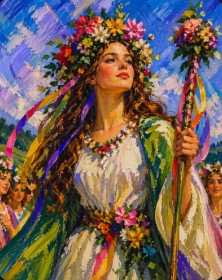
At the center of many of those celebrations was the May Queen. She was not a distant or royal figure in the modern sense. She was usually a young woman chosen from the community, someone who seemed to carry the brightness of the season naturally. There was something about her that reflected what was happening in the land itself. She became a living symbol of Beltane, representing the world in bloom.
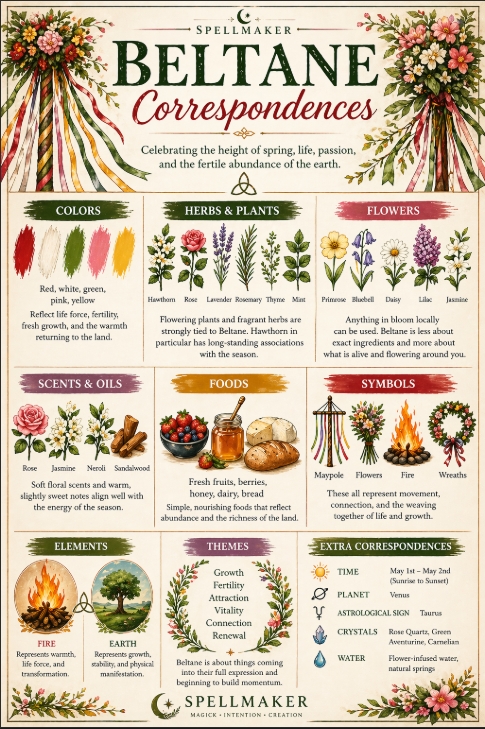
On the morning of the celebration, she would be crowned with flowers. Hawthorn, primrose, bluebells, whatever was blooming locally would be woven into her hair or shaped into a crown. Her clothing was often light and simple, meant to echo the softness and color of the season rather than stand apart from it. She did not stand above the people. She moved among them, leading processions, dancing, or simply being present as the celebration unfolded.
Her role was not about status. It was about embodiment. The May Queen made the energy of Beltane visible. She represented the moment when life is no longer returning but has fully returned. Where earlier spring is fragile and uncertain, Beltane is confident. Open. Alive. She carried that energy so the whole community could see it, feel it, and celebrate it together.
In some traditions, she is paired with the Green Man, a figure representing the wild, growing force of nature. Where she is blossom and beauty, he is leaf and root. Together, they reflect the balance of growth that defines the season. But even on her own, the May Queen stands as a clear expression of what Beltane holds. She is not potential. She is fulfillment.
There is also something quieter and more meaningful in her story. The May Queen is not meant to hold her role forever. She belongs to a moment in the turning of the year. She is crowned when the season calls for her, and when that moment passes, she steps back into ordinary life. The crown is not something she keeps. It is something she carries for a time.
That is part of what makes her powerful. She represents those moments in life when everything feels open, alive, and possible. Times when you step forward, when you are seen, when something within you is fully expressed. And just as naturally, there are times when that energy recedes and changes into something quieter.
The May Queen does not cling to the season or try to hold it in place. She moves with it. She embodies it while it is here, and when it shifts, she lets it go.
In that way, her story is not just about spring or celebration. It is about recognizing when something is ready to bloom, stepping into it fully, and trusting that when the time comes, it will change into something else.
In Service,
Sister Bridget