Every year on March 17, the world turns green. People gather for parades, Irish music, good food, and a toast or two in honor of St. Patrick, the patron saint of Ireland. Shamrocks appear everywhere, stories of saints and serpents are told, and the day takes on that cheerful, celebratory feeling that comes with the first hints of spring.
But St. Patrick is not the only holy figure connected with March 17.
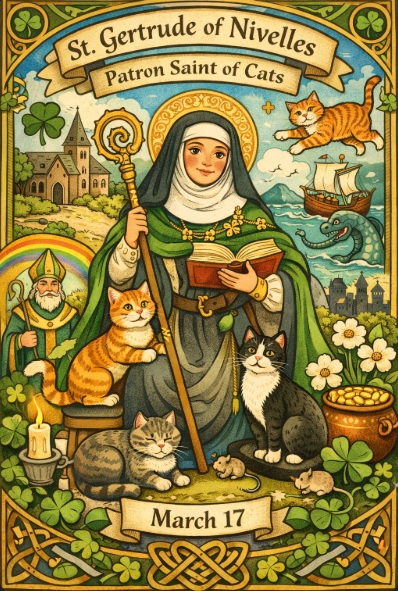
The same day is also the feast day of St. Gertrude of Nivelles, a lesser-known saint from the early Middle Ages who has quietly earned a reputation among animal lovers as the unofficial patron saint of cats.
While the Vatican has never formally declared her the patron saint of felines, folklore, history, and a good deal of medieval artwork have firmly connected her with our whiskered companions.
And once you hear the story, it makes a surprising amount of sense.
St. Gertrude was born in the year 626 in the town of Nivelles, in what is now modern-day Belgium. She came from a wealthy and influential family during the Merovingian period of European history. Even as a child, Gertrude showed a strong desire for religious life.
This led to a dramatic moment when she was only about ten years old.
At a banquet held by her father, a nobleman asked that Gertrude be promised in marriage to the son of a duke. Such arrangements were common among noble families at the time, often made to strengthen alliances and social standing.
But Gertrude shocked everyone present by firmly refusing.
She declared that she would marry no earthly man and that Christ would be her bridegroom. It was an unusually bold statement for a young girl in the seventh century, but it set the course for the rest of her life.
A few years later, Gertrude’s mother founded a monastery at Nivelles. Interestingly, it was a double monastery, meaning it housed both monks and nuns, something that was not unheard of in early medieval Europe but still relatively rare.
After her mother’s death, Gertrude eventually became the abbess of the community.
She was known for her deep devotion to prayer, her learning, and her hospitality toward travelers and pilgrims who passed through the region. In an era when long journeys were dangerous and difficult, monasteries often served as places of refuge. Gertrude welcomed visitors generously, and over time she became known as a protector of travelers and pilgrims.
Her dedication to spiritual life, however, was intense.
Like many saints of the early church, she practiced strict asceticism. She fasted frequently, slept very little, and devoted long hours to prayer. These practices gradually weakened her health. By the time she was thirty-two years old, she had become too ill to continue serving as abbess and stepped down from the role.
She died not long afterward, on March 17 in the year 659, at the age of thirty-three.
Almost immediately after her death, people began honoring her as a saint. Stories circulated of miracles attributed to her prayers and protection. She was said to have saved her monastery from fire, restored sight to the blind, revived a drowned child, and protected travelers in dangerous situations.
One medieval legend even tells of sailors who prayed to St. Gertrude during a storm at sea when a giant sea creature rose from the water and threatened their ship. After they called upon her for help, the creature vanished and the sailors reached shore safely.
Because of stories like this, medieval travelers sometimes toasted St. Gertrude before beginning a journey.
Over time, she became associated with a wide range of patronages, including pilgrims, gardeners, widows, and those suffering from illness or fever.
But the story of how she became linked to cats begins with something much smaller.
Mice.
In late medieval artwork, St. Gertrude often appears holding an abbess’s staff while mice run at her feet or climb along the crozier. At first glance it seems like a strange detail, but there are several explanations.
One theory comes from medieval symbolism. In parts of the Netherlands, mice were sometimes used to represent souls in Purgatory, the place where Catholics believed souls were purified before entering heaven. Because Gertrude was known for praying constantly for the souls of the departed, the mice may have symbolized the spirits she interceded for.
Another explanation is far more practical.
According to legend, the monastery at Nivelles once suffered from a serious mouse infestation that threatened their grain stores. Gertrude prayed for relief, and the mice disappeared. After her death, people began invoking her protection against rats and mice, which were major threats to food supplies in medieval communities.
And where there are mice, there are usually cats.
Monasteries across Europe commonly kept cats to protect grain stores, manuscripts, and kitchens from rodents. Cats were valued working animals, quiet guardians of the pantry and library.
So if St. Gertrude protected homes and monasteries from mice, it was only natural that her reputation would extend to the animals who helped control them.
By the late Middle Ages, the connection between St. Gertrude and cats had become firmly rooted in folklore.
In modern times, the idea gained renewed attention when a 1981 publication from the Metropolitan Museum of Art referred to St. Gertrude of Nivelles as the patron saint of cats. The title quickly caught on, especially among cat lovers who were delighted to discover that their favorite animals had a saintly advocate.
Today, while her patronage of cats remains unofficial, St. Gertrude is widely celebrated as their gentle protector.
So the next time March 17 arrives and the world fills with shamrocks and St. Patrick’s Day celebrations, it may be worth remembering that another saint shares the day.
St. Gertrude of Nivelles, the quiet abbess of a seventh-century monastery, left behind a legacy of hospitality, prayer, and care for the small creatures who shared her world.
And for anyone who lives with a cat curled beside them on a chair, windowsill, or altar, that connection feels surprisingly fitting.
After all, homes guarded by cats have always had a certain kind of magic. 🐈🍀
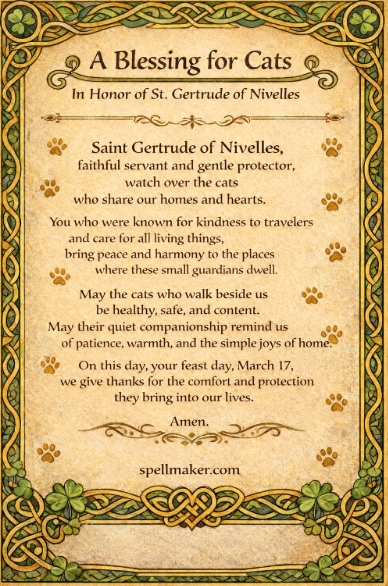
Please print out and enjoy this prayer card for St. Gertrude! Hold it between your hands while praying, place it near a photo of your beloved feline or near their bed if they might be under the weather.