Tag: may day

  • BELTANE! A Time for Renewal.

    Hello, everyone!

    Happy May to all. Spring often brings about a sense of renewal in us.  The trees, birds, and earth itself seem to be coming out of their long winter's sleep.

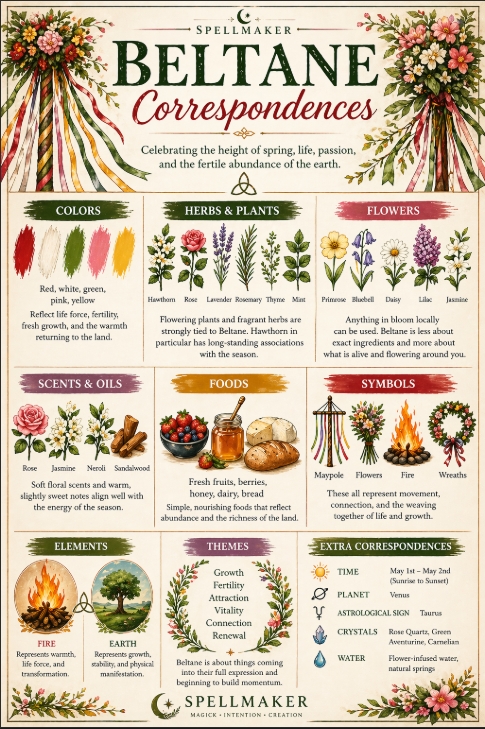
    One of the rituals performed on May 1 is burning a fire for Beltane.  Of course, this is also considered "May Day" and is known by other names as well.  It is a ritual stemming from Old Gaelic tradition and is celebrated by many Wiccans, Pagans, and other spiritual groups.  It is about renewal, protection, fertility,asking for abundance in crops, safety for our children and animals, etc.  It is a fun holiday and can be simple, as ours was, or can be much more elaborate (next year, we hope!). In my opinion, you don't have to be any particular religion to benefit from this cleansing and protecting ritual!

    Parran Matt and I did the ritual part as the High Priest and Priestess and Sister Bridget was the May Queen.  It was simple but powerful with a ritual fire for Beltane.  We said our parts and walked around the smoke of the fire to ask for protection and prosperity for ourselves and all those we know and love.

    I had mentioned that if people saved their ashes, I would tell them how to use them and here I am to do that!

    There are several ways to use these ashes.  After reading the list, you might think of some creative ways of your own.  I would love to hear them!

    1.   They are used are for protection.  Putting the ashes around the ground of your home.  It just takes a little bit.  Sometimes they are used on one's body – just rubbing a little bit around your heart area if you are going into a dangerous or scary situation is said to help protect you. It can also be put around areas where you keep animals.

    2.  The ashes are used to encourage growth.  People scatter them in the garden, potted plants, yards, and fields, anywhere that you want to encourage growth.  This growth can also be in the form of luck, having enough food, providing for your family, etc.

    3.  They can also be used to encourage spiritual growth.  A little bit can be put in a bath or even mixed in with some kind of oil and anoint yourself with the oil and ashes.  If you are a Vodouisant, or like to use Spellmaker oils, you can definitely mix a few of these ashes in any of our oils that would be used to encourage growth of any kind.

    4.  If your fire was big enough that it left you coals, you can use those coals in magickal writings, veves, wards, drawings of magickal symbols, etc. Commonly, the coals used for writing would be used for petitions in love, life, luck, abundance… rarely is the word "money" used at this time.  Mostly it is "abundance, plenitude, bounty" or some similar word. 

    5.  Some people like to save a coal and put in a little bag and use it as a protection charm year round, returning it to the Beltane fire the next year.  Then they get another coal from the new fire, and so forth and so on.

    6.  It isn't uncommon to even mix a little bit of the ash into a big glass of water and drink it.  This is said to encourage protection from hexes, enemies, and illness.  At one time, these ashes were used as medicine, put into wounds, etc.  They are said to aid in fertility.  Please use common sense if you are going to imbibe the ashes.

    7.  What are your ideas?  If you bear in mind that these ashes are meant to cleanse, protect, and represent renewal, you might find some very creative ways to use them yourself!

    So there are some ways to use your ashes!  I also wanted to mention that one should not mix up this tradition with the Catholic tradition of getting ashes on your forehead on Ash Wednesday.  That is about repentance and humilty.  Actually, there are lots of ways that different ashes are used in spiritual rituals – might expand on this topic later!

    Peace out, kiddos,

    Mambo Samantha Corfield, www.spellmaker.com

    P.S.  Look for our mighty stag in the pictures!  You can barely see him! LOL

      Beltanehome


  • Freya, a May Queen.


    “With a crown of the lilies of light —

    For a maiden they crowned her in May,
     For the Queen of the Daughters of Day
     That are flowers of the forest of Night.”

    ~~~May Queen by Aleister Crowley


    Freya, a May Queen.

    Yesterday, during our Family Beltaine/ May Day activities, I played the role of the May Queen.  Mambo Sam spoke about the holiday and its significance, and how it is celebrated in many cultures across the world. Today, I was doing some reading about the May Queen and how she is represented in other places and times. I found myself drawn to some information about Freya, an important Germanic Goddess.  Her main festival is May Day.  Walpurgisnacht ‘Walpurga’s Night,’ when the festival actually begins, is April 30, the evening before May Day is named for Freya.  This time of year coincides loosely with the first dew fall, that is the time of year when frost no longer forms at night, but rather the temperature remains above freezing at least for some of the nights. This change in the weather allows the growth of green things and the blooming of all the flowers. This in turn allows for the cattle to be turned out of their winter quarters and released to  graze on the new grass which increases the amount and quality of milk available to humans.

    Walpurgisnacht is not named after St. Walburga, as is commonly said. However, the saint’s name became attached to the festival as a way of “explaining” the meaning of the name of the holiday. St. Walburga’s feast day is set to May 1st because that was already the name of a major festival of Freya. The pretense that the festival of Walpurgisnacht is named for St. Walburga provides a convenient way of obscuring the festival’s older Pagan origin.

    Freya’s domain is the garden, especially a walled garden with fruit trees, properly an orchard with a spring or well. She is responsible for making the flowers bloom and she is always associated with flowers especially flowering trees. As a Goddess of spring time, she is especially associated with romantic love among human beings. Songs of love are well-pleasing to her; it is good to call on her for furtherance in love.

    An important event in the changing of the seasons was the moving of livestock from their winter pastures to summer pastures, and vice versa.  In some areas of Europe, as the weather permitted, cattle were moved to summer pastures during the May Day/ Walpurgis/ Spring  time festivities and Freya was invoked for their protection and fertility.

    The following Middle High German charm is to protect cows when they are turned out into the forest, as they were in spring in northern Europe. The exact date would depend on the climate and when the grass was sufficient to support the cattle, though some traditions closely associate this prayer with May Day and associated festivities. “Lady” may refer to the Goddess Freya, the Virgin Mary, or to any unspecified but highly respected woman. The ambiguity may be intentional, and possibly life-saving, since people could ask for assistance from the Goddess while pretending to refer to one of the Christian deities.

    Herdsman’s Charm to Protect Cows

    Today my herd I drove into our Lady’s grove,
    Into Abraham’s garden; Be, good St. Martin,
    this day my pledge and warden,
    and good St. Wolfgang, good St. Peter,
    (whose key can heaven unlock),
    throat of wolf and vixen block,
    against blood shedding, and bone shredding.
    Help me, holy one, who ill hath never done,
    and [by] his five holy wounds;
    keep my herd from all wood-hounds!
    [Say] 5 Pater Nosters (Our Fathers) and 5 Hail Marys

    StampIMG_0345v2


    Hope you enjoyed reading about this as much as I did!

    Love

    Sister Bridget