Tag: ESP

  • The Difference Between Anxiety and Intuition

    The Difference Between Anxiety and Intuition

    The Difference Between Anxiety and Intuition

    One of the most common spiritual struggles people face is learning the difference between anxiety and intuition.

    At first glance, the two can feel surprisingly similar.

    Both create strong feelings. Both can arrive suddenly. Both can make your attention lock onto a person, situation, or decision until it becomes difficult to think about anything else.

    But anxiety and intuition are not the same thing at all.

    Learning to recognize the difference can bring enormous peace, especially for sensitive people who tend to absorb emotional energy very deeply.

    Anxiety is loud.

    Intuition is quiet.

    That is often the simplest way to begin understanding the difference.

    Anxiety tends to spiral. It repeats itself endlessly like a smoke alarm with dying batteries. It demands immediate action. It pushes urgency, fear, worst-case scenarios, and constant over-analysis.

    “What if something terrible happens?”
    “What if I made the wrong choice?”
    “What if they leave?”
    “What if I fail?”
    “What if I missed a sign?”

    Anxiety rarely brings clarity. Instead, it creates loops. The mind races in circles searching for certainty that never fully arrives.

    Intuition feels very different.

    Intuition is usually calm, direct, and surprisingly simple. It often arrives as a brief inner knowing before fear has time to interrupt it. Sometimes it is only a quiet feeling in the body. A pause. A pull. A sense that something is either right or wrong without being able to fully explain why.

    Unlike anxiety, intuition does not usually scream.

    It nudges.

    Anxiety often feels frantic in the body as well. Tight chest. Racing thoughts. Restlessness. Compulsive checking. Difficulty relaxing. It feeds on repetition and tends to grow louder the more attention you give it.

    Intuition usually feels steadier.

    Even when intuition warns us about something difficult, it often carries a strange sense of clarity beneath it. The message itself may not be pleasant, but it does not feel chaotic. There is less emotional static attached to it.

    For example, anxiety may say:
    “They hate me. Something is wrong. I need to text again right now.”

    Intuition may quietly say:
    “This situation feels unhealthy for me.”

    One spirals outward endlessly.

    The other simply knows.

    Another important difference is that anxiety is often rooted in fear of the future, while intuition exists very much in the present moment.

    Anxiety tries to predict and control every possible outcome. It wants guarantees. It wants certainty. It wants absolute reassurance before allowing you to rest.

    Intuition does not usually explain itself that thoroughly.

    Sometimes intuition simply says:
    “Do not go there.”
    “Call this person.”
    “Wait.”
    “Pay attention.”
    “Something feels off.”

    And then it becomes quiet again.

    Many people struggle with intuition because they keep waiting for it to sound dramatic. They expect thunderbolts, visions, or unmistakable signs. But intuition is often subtle. The first whisper is usually the clearest one before fear and overthinking rush in to bury it under mental noise.

    Modern life makes this even harder.

    People today are overstimulated constantly. Phones buzzing. News alerts. Endless scrolling. Stress. Financial pressure. Emotional exhaustion. The nervous system rarely gets a chance to settle long enough for intuition to rise clearly to the surface.

    When people are overwhelmed, anxiety can begin impersonating intuition.

    That is why grounding matters so much.

    Rest matters.
    Sleep matters.
    Silence matters.
    Stepping away from constant noise matters.

    A frightened nervous system cannot always interpret spiritual or emotional signals clearly.

    One helpful exercise is to pause and ask yourself:
    “Does this feeling bring clarity or confusion?”

    Anxiety usually creates confusion.

    Intuition usually creates clarity, even if the answer is uncomfortable.

    Another helpful question is:
    “Is this feeling growing louder because I keep feeding it?”

    Anxiety feeds on attention. The more we check, analyze, panic, and seek reassurance, the larger it becomes.

    Intuition does not usually demand obsession.

    It simply remains present until acknowledged.

    This does not mean intuition is always perfect or that anxiety should be ignored completely. Anxiety can sometimes alert us that something in our lives genuinely needs care or attention. But living in a constant state of fear makes it difficult to hear our deeper inner wisdom clearly.

    Part of spiritual growth is learning how to become still enough to recognize your own inner voice again.

    That takes patience.

    And gentleness.

    Not every fearful thought is a prophecy.
    Not every coincidence is a sign.
    Not every feeling deserves immediate action.

    Sometimes the most spiritual thing a person can do is pause, breathe, ground themselves, and listen carefully before reacting.

    Intuition tends to arrive quietly.

    Fear tends to pound on the door.

    Learning the difference between the two can change your entire relationship with yourself.

    In Service,

    Sister Bridget

    spellmaker.com
  • Simple Exercises to Strengthen Your Intuition

    Simple Exercises to Strengthen Your Intuition

    Simple Exercises to Strengthen Your Intuition

    Intuition is a little like a muscle. The more you use it, the easier it becomes to recognize its voice.

    The problem is that most people spend years talking themselves out of their instincts. They second-guess themselves, dismiss feelings as “silly,” or ignore the quiet inner nudges that do not seem logical enough to trust.

    But intuition rarely arrives as a booming announcement.

    More often, it slips in softly. A feeling. A hesitation. A sudden certainty. A tiny inner whisper saying, “Pay attention.”

    The good news is that intuition can absolutely be strengthened through practice. You do not need special gifts, expensive tools, or complicated rituals to begin. In fact, some of the best exercises are simple enough to fit into everyday life.

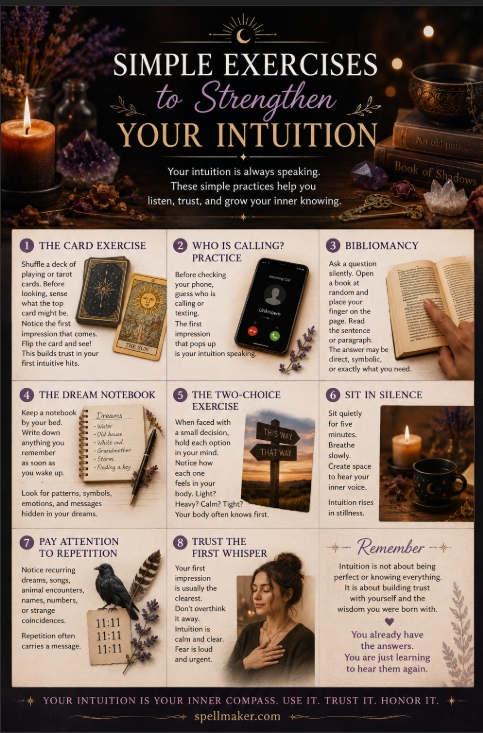
    The Card Exercise

    Take a deck of playing cards or tarot cards and shuffle them well.

    Before turning over the top card, pause for a moment and try to feel what is there. Do not overthink it. Notice the first impression that comes to mind:

    • red or black
    • major or minor arcana
    • hearts or spades
    • masculine or feminine energy
    • fast or slow feeling

    Then flip the card over and see what you got right.

    This exercise is not about perfection. It is about learning the feeling of intuition before the logical mind barges in wearing muddy boots and shouting opinions.

    The “Who Is Calling?” Practice

    Before checking your phone when it rings or buzzes, stop for one second and guess who it is.

    Again, do not force it. Let the first impression rise naturally.

    Most people are surprised how often they begin getting little hits once they start paying attention.

    Bibliomancy

    This is an old divination method that is beautifully simple.

    Take a favorite spiritual book, poetry collection, Bible, folklore book, or even a beloved novel. Quiet your mind, ask a question silently, then open the book at random and place your finger somewhere on the page.

    Read the sentence or paragraph.

    Sometimes the answer is startlingly direct. Sometimes symbolic. Sometimes oddly comforting in exactly the right way.

    The Dream Notebook

    Dreams are one of the oldest roads into intuition.

    Keep a notebook beside your bed and write down anything you remember immediately upon waking, even fragments:

    • colors
    • people
    • symbols
    • emotions
    • repeating locations
    • unusual animals
    • phrases

    Over time, patterns often emerge. Certain symbols may become deeply personal to you. Water may always appear before emotional events. Roads may show up during periods of transition. Specific people may repeatedly appear as messengers or warnings.

    The act of recording dreams also signals to the subconscious that you are listening.

    The Two-Choice Exercise

    When faced with a small decision, pause before choosing.

    For example:

    • Which route should I drive?
    • Which book should I read next?
    • Which candle should I light tonight?
    • Which email should I answer first?

    Hold one option in your mind, then the other.

    Notice how each one feels in your body. Light? Heavy? Calm? Tight? Open? Resistant?

    Intuition often speaks through physical sensation before words.

    Sit in Silence for Five Minutes

    This sounds deceptively easy.

    Most people are so surrounded by noise that they rarely hear their own inner voice anymore. Phones buzz. Videos autoplay. Thoughts race constantly like raccoons fighting in a dumpster behind the mind.

    Five quiet minutes can feel strangely uncomfortable at first.

    But silence creates space for intuition to rise.

    Light a candle if you wish. Sit comfortably. Breathe slowly. Do not demand messages or visions. Simply become still enough to notice what naturally surfaces.

    Pay Attention to Repetition

    One of the strongest intuition exercises is simply observing your own life more carefully.

    Notice:

    • recurring dreams
    • repeating songs
    • certain animals appearing frequently
    • names that keep surfacing
    • strange coincidences
    • sudden emotional pulls toward places, objects, or people

    The goal is not paranoia or obsession. Not every bird is a prophecy from the universe. Sometimes a crow is simply a crow being gloriously loud and judgmental from a fence post.

    But repetition often carries meaning.

    Trust the First Whisper

    One of the biggest intuition killers is over-analysis.

    Many people receive an intuitive impression immediately, then spend the next twenty minutes arguing with themselves until the original feeling disappears under a pile of mental paperwork.

    Practice honoring the first whisper.

    Not every feeling will be correct. That is normal. Intuition develops through use, patience, and discernment over time.

    The important thing is learning to recognize the difference between genuine inner knowing and fear-driven spiraling.

    Intuition usually feels calm and clear.

    Fear usually feels loud and urgent.

    Final Thoughts

    Strengthening intuition is less about becoming “psychic” and more about rebuilding trust with yourself.

    Your inner voice has likely been speaking your entire life.

    The real practice is learning how to hear it again.

    In Service,

    Sister Bridget

    spellmaker.com