Where earlier spring is about waking up, Beltane is about things actively growing. Energy is warmer, faster, more outward. It’s a good time to look at where things are opening, what’s gaining momentum, and what’s ready to be encouraged forward.
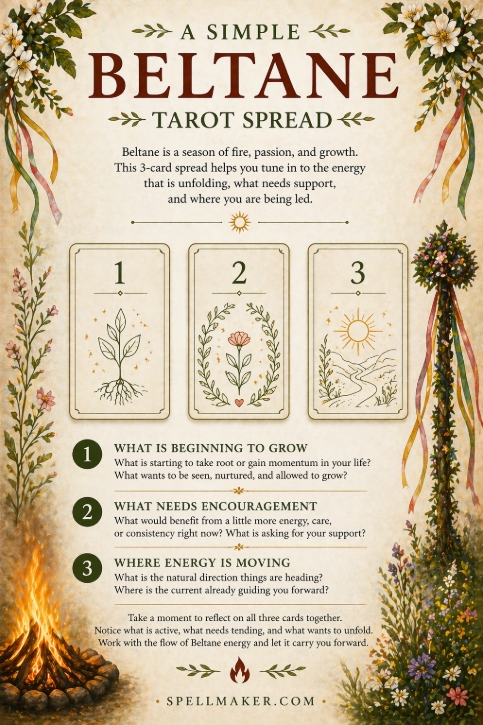
This three-card spread keeps it simple and focused.
Shuffle your cards, take a breath, and lay out three cards from left to right.
Card One: What Is Beginning to Grow This card shows what is starting to take root or gain momentum in your life. It may still be small or uncertain, but there is life in it. This is where your attention naturally wants to go right now.
Card Two: What Needs Encouragement This card points to something that would benefit from a little more energy, care, or consistency. Not force, just support. It may already be present, but it hasn’t fully opened yet.
Card Three: Where Energy Is Moving This card shows the direction things are naturally going if you allow them to unfold. It helps you see where the current is already carrying you, so you’re working with movement instead of against it.
Take a moment to look at all three together.
Notice what feels active, what feels steady, and what feels like it’s asking for a little more attention. Beltane is not about pushing everything forward at once. It’s about recognizing where there is life and giving it space to grow.
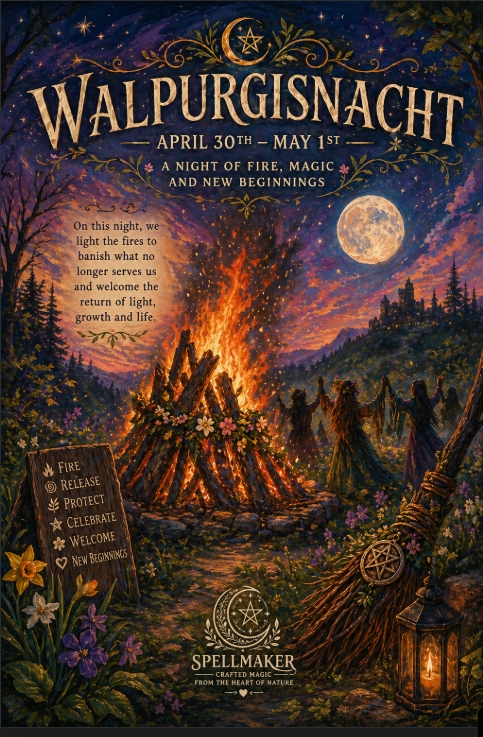
Walpurgisnacht arrives like a spark at the edge of night, that moment when winter finally loosens its grip and the world leans toward warmth again. Celebrated on the evening of April 30th into May 1st, it sits right on the threshold between seasons. Not quite spring, not quite summer. A doorway night.
Its roots reach back into old European traditions, especially in Germany and parts of Scandinavia, where people gathered on hilltops, lit great bonfires, and kept watch until dawn. The fires were not just for warmth or celebration. They were believed to drive away lingering spirits, clear out stagnant energy, and protect the land as it shifted into a new cycle of growth. There is something deeply human about that instinct. When the world changes, we light a fire and stand together.
The name itself comes from Saint Walpurga, a Christian abbess whose feast day falls on May 1st. Over time, her name became woven into older folk traditions, blending sacred and seasonal meanings together. But if you listen closely beneath the name, you can still hear the older rhythm. This is a night of crossing over. A night when the veil feels thin, not in a heavy or somber way, but in a lively, electric one. The kind of energy that hums just under your skin.
In folklore, Walpurgisnacht became known as a night when witches gathered. Not in the fearful, storybook sense meant to scare people into staying indoors, but in a much older sense. Women and wise folk meeting under open sky, marking the turning of the wheel, celebrating fertility, growth, and the return of life. The stories grew wilder over time, as they tend to, but underneath them is something familiar. Community. Firelight. Laughter carried on the wind.
There is a beautiful contrast in this night. It holds both protection and celebration. The bonfires were meant to banish what no longer belonged, while the gatherings welcomed what was coming in. It is both a clearing and a calling. A release and an invitation.
If you want to honor Walpurgisnacht in a simple, grounded way, it does not have to be elaborate. Step outside if you can, even for a few minutes. Notice the air. There is a certain softness to it, even in places where spring comes slowly. Light a candle or a small fire if it is safe to do so. Let it represent what you are ready to let go of. Old fears, old stories, anything that has overstayed its welcome.
Then, just as important, take a moment to call something in. Not in a grand, complicated way. Just a quiet intention. Growth. Stability. Peace. Opportunity. Whatever feels right for you in this season of your life.
Some people like to leave a small offering for the land or for spirit on this night. A bit of bread, a splash of milk, a handful of flowers. It does not have to be perfect. It is the gesture that matters. A way of saying, I see this moment. I am part of this turning.
Walpurgisnacht flows naturally into Beltane, which carries that same energy forward into full bloom. Where Walpurgisnacht is the spark, Beltane is the flame. Together, they mark one of the most alive points of the year.
There is something steadying about these old nights. They remind us that change is not sudden or chaotic. It comes in waves, in seasons, in cycles we can learn to recognize. Even when life feels uncertain, the wheel keeps turning.
Tonight, the fires burn. The air shifts. The world tilts toward light.
And somewhere, just beyond what we can see, something is waking up again.
Long before calendars told people when spring had arrived, they felt it. It came in the lengthening light, in the warming air, in the way the earth itself seemed to stretch and breathe again. By the time Beltane arrived, spring was no longer tentative. It was alive, visible, undeniable.
Beltane marks that turning point in the year when everything is in motion. Growth is no longer beginning. It is happening. Trees are leafed out, flowers are open, and the land itself feels full. It’s a celebration of life at its most active and visible, and people have always found ways to reflect that back in human form.
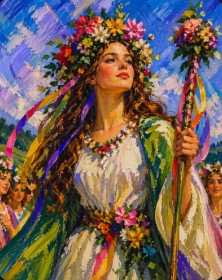
At the center of many of those celebrations was the May Queen. She was not a distant or royal figure in the modern sense. She was usually a young woman chosen from the community, someone who seemed to carry the brightness of the season naturally. There was something about her that reflected what was happening in the land itself. She became a living symbol of Beltane, representing the world in bloom.
On the morning of the celebration, she would be crowned with flowers. Hawthorn, primrose, bluebells, whatever was blooming locally would be woven into her hair or shaped into a crown. Her clothing was often light and simple, meant to echo the softness and color of the season rather than stand apart from it. She did not stand above the people. She moved among them, leading processions, dancing, or simply being present as the celebration unfolded.
Her role was not about status. It was about embodiment. The May Queen made the energy of Beltane visible. She represented the moment when life is no longer returning but has fully returned. Where earlier spring is fragile and uncertain, Beltane is confident. Open. Alive. She carried that energy so the whole community could see it, feel it, and celebrate it together.
In some traditions, she is paired with the Green Man, a figure representing the wild, growing force of nature. Where she is blossom and beauty, he is leaf and root. Together, they reflect the balance of growth that defines the season. But even on her own, the May Queen stands as a clear expression of what Beltane holds. She is not potential. She is fulfillment.
There is also something quieter and more meaningful in her story. The May Queen is not meant to hold her role forever. She belongs to a moment in the turning of the year. She is crowned when the season calls for her, and when that moment passes, she steps back into ordinary life. The crown is not something she keeps. It is something she carries for a time.
That is part of what makes her powerful. She represents those moments in life when everything feels open, alive, and possible. Times when you step forward, when you are seen, when something within you is fully expressed. And just as naturally, there are times when that energy recedes and changes into something quieter.
The May Queen does not cling to the season or try to hold it in place. She moves with it. She embodies it while it is here, and when it shifts, she lets it go.
In that way, her story is not just about spring or celebration. It is about recognizing when something is ready to bloom, stepping into it fully, and trusting that when the time comes, it will change into something else.
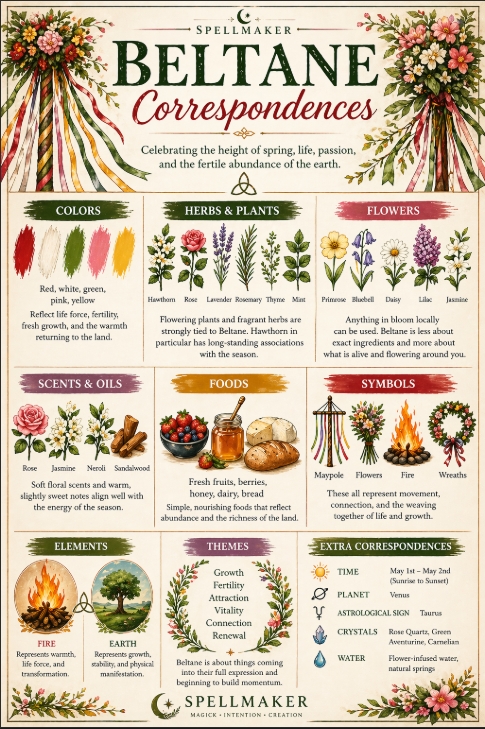
Beltane marks the height of spring, when life is no longer waking up but fully in motion. The energy of the season is warm, active, and outward-moving. It’s a time connected to growth, attraction, vitality, and the visible return of life in the natural world.
These correspondences give you a simple way to connect with that energy, whether you’re doing something intentional or just paying attention to the season around you.
Colors Red, white, green, pink, yellow These reflect life force, fertility, fresh growth, and warmth returning to the land.
Herbs and Plants Hawthorn, rose, lavender, rosemary, thyme, mint Flowering plants and fragrant herbs are strongly tied to Beltane. Hawthorn in particular has long-standing associations with the season.
Flowers Primrose, bluebell, daisy, lilac, jasmine Anything in bloom locally can be used. Beltane is less about exact ingredients and more about what is alive and flowering around you.
Scents and Oils Rose, jasmine, neroli, sandalwood Soft floral scents and warm, slightly sweet notes align well with the energy of the season.
Foods Fresh fruits, berries, honey, dairy, bread Simple, nourishing foods that reflect abundance and the richness of the land.
Symbols Maypole, flowers, ribbons, fire, wreaths These all represent movement, connection, and the weaving together of life and growth.
Elements Fire and Earth Fire represents warmth, life force, and transformation. Earth represents growth, stability, and physical manifestation.
Themes Growth, fertility, attraction, vitality, connection, renewal Beltane is about things coming into their full expression and beginning to build momentum.
You don’t need to use all of these.Even noticing one or two of them in your day is enough to connect with the season. A flower on the table, a window open to warm air, a candle lit in the evening. Beltane tends to meet you halfway.
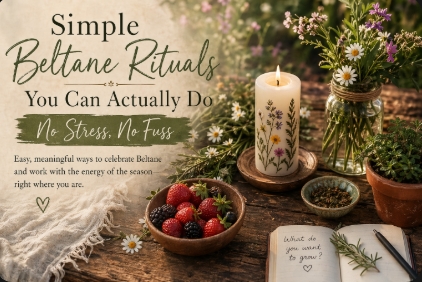
Beltane has a reputation for being elaborate. When people think of it, they picture big rituals, flower crowns, candles everywhere, and a whole atmosphere that looks beautiful but can feel like a lot to pull off, especially if you’re just trying to get through a normal week. The truth is, Beltane doesn’t need any of that to be meaningful. At its core, it’s about life waking back up again. It’s about energy starting to move, things beginning to grow, and you reconnecting with that in whatever way you can manage.
Instead of turning it into a production, it helps to bring it down to something real and doable. Beltane works just as well in small, quiet moments as it does in larger rituals. In fact, for most people, those smaller moments are where the shift actually happens. You don’t need a perfect setup or a long list of tools. You just need a willingness to participate, even in a simple way.
One of the easiest ways to connect with this energy is to step outside for a few minutes and let yourself be present there. No phone, no distractions, just a moment to notice the air, the temperature, and what’s changing around you. It doesn’t have to be a long experience, and it doesn’t have to feel profound. Simply being outside and paying attention is enough to start that reconnection. If you want to add a quiet intention, something as simple as “I’m ready to wake up with the season” is more than enough.
Another practical approach is working with a candle, but keeping it straightforward. You don’t need a specific color or a complicated ritual. Light what you have, and take a moment to focus on one thing you want to grow in your life right now. Keeping it to a single, clear idea makes it more grounded and easier to hold onto. You can sit with that thought for a minute or two, then move on with your day. The act itself is what matters, not how long or elaborate it is.
Food is another way to connect with Beltane that people often overlook. This is a very physical time of year, tied closely to nourishment and the body. Taking a few minutes to eat something without rushing or multitasking can be a quiet but powerful way to bring yourself back into the moment. It doesn’t need to be anything special. What matters is that you’re present with it, reminding yourself that you’re here and able to experience something simple and good.
If you have the ability, planting something can be a meaningful addition, but it doesn’t need to be a full garden or even a permanent setup. A small pot, a handful of soil, or even a single seed in a cup is enough. As you plant it, you can think about what you’d like to grow alongside it in your own life, keeping that thought simple and natural. After that, you let it be. There’s no need to overthink it or turn it into an ongoing ritual. Just care for it as you normally would and let it develop in its own time.
At the same time, Beltane isn’t only about adding things. It’s also about making space. Letting go of something small but real can be just as important as planting something new. This doesn’t have to be dramatic or ceremonial. It can be as simple as deciding you’re not going to carry a certain thought or frustration in the same way anymore. You can write it down and throw it away, or just acknowledge it quietly and move on. The shift comes from the decision itself.
The reality is that Beltane doesn’t require you to feel a certain way or to do everything perfectly. You don’t have to be full of energy or inspiration for it to matter. It meets you exactly where you are. If all you do is step outside and take a breath, that counts. If you light a candle and take a quiet moment, that counts. If you sit down and eat something with a little more awareness, that counts too.
It isn’t about creating a perfect ritual. It’s about showing up, even in small ways, and allowing things to start moving again.
There’s this quiet pressure people don’t talk about much, the idea that once something hurts you, you should be “over it.” That if someone disappointed you, pulled away, or left you confused, the right response is to shut the door, lock it, and never look back.
But that’s not how the heart works.
Sometimes you can see something clearly and still care. Sometimes you can know a situation isn’t right and still feel connected to it. Sometimes you can be hurt and still miss the person who hurt you.
None of that makes you weak. It makes you human.
Feelings don’t follow logic. They don’t switch off just because something didn’t go the way you hoped. The connection you felt, the moments you shared, the meaning you gave it, those things don’t disappear overnight just because the situation changed.
And trying to force yourself not to care can actually make things harder.
You might find yourself thinking, “Why am I still like this?” or “I should be past this by now.” But there is no fixed timeline for the heart. There is no rule that says you have to feel a certain way by a certain day.
You’re allowed to take your time with it.
Caring doesn’t mean you have to go backwards. Caring doesn’t mean you have to reach out. Caring doesn’t mean you have to accept less than you deserve.
It just means that what you felt was real to you.
And that matters.
There is a difference between holding onto someone in a way that hurts you and simply acknowledging that a part of you still cares. One keeps you stuck. The other is just honesty.
You don’t have to fight your feelings to move forward. You don’t have to erase someone to begin again.
Sometimes healing looks less like letting go all at once and more like gently loosening your grip over time, while still allowing yourself to feel what you feel.
You can care and still choose yourself. You can miss someone and still move forward. You can hold the memory without letting it hold you.
There’s nothing wrong with your heart for taking its time.
In fact, that softness, the part of you that still cares, is the same part of you that will recognize something real when it comes along again.
It’s easy to feel like you’re not getting anywhere.
When you’re in the middle of something emotional, especially something complicated, it can feel like you’re going in circles. One day you feel strong and clear, and the next day you’re right back in the same thoughts, the same feelings, the same questions.
It can make you wonder if anything is actually changing at all.
But it is.
Progress doesn’t always look like a clean break or a big, obvious shift. Most of the time, it’s much quieter than that. It shows up in small moments that are easy to miss if you’re only looking for something dramatic.
It might look like pausing before you respond instead of reacting right away. It might look like noticing something that doesn’t feel right, even if you don’t act on it yet. It might look like needing a little more space than you used to.
Those things matter.
Even the fact that you’re thinking about your situation differently means something is moving. Awareness is a kind of progress, even if nothing on the outside has changed yet.
And there will be days that don’t feel like progress at all.
Days where you miss them more. Days where you question everything. Days where it feels like you’ve taken ten steps back.
That doesn’t erase the ground you’ve already covered.
Healing doesn’t move in a straight line. It shifts, it pauses, it loops back on itself sometimes. That doesn’t mean you’re failing. It means you’re working through something that matters to you.
You don’t have to be perfect at this.
You don’t have to have all the answers right now. You don’t have to be completely over it to be moving forward.
You’re allowed to be in the middle of it.
Take a moment and look at yourself with a little more kindness than you’re used to.
You’re still here. You’re still trying. You’re still choosing to move forward, even when it’s slow.
That counts for more than you think.
You may not feel strong every day, but the fact that you keep going, even in small ways, says more about your strength than any single “good” day ever could.
There’s a moment every year when you go outside, look up, and realize something is missing.
You don’t notice it right away. The sky still looks like the sky. There are still stars, still that familiar hush that settles in after sunset. But then it hits you.
Orion is gone.
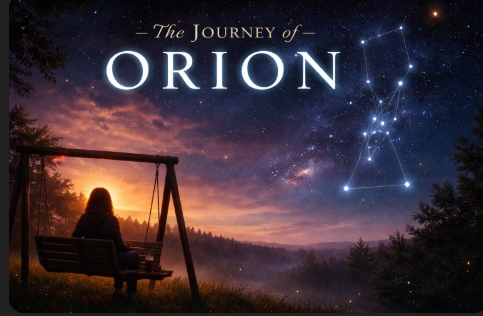
If you’ve ever learned to recognize him — really recognize him — it feels strange. His three-star belt is so steady, so easy to find, that once you know it, you start to expect it. It becomes part of your sky. Part of your rhythm.
And then one night, he’s just… not there.
But here’s the thing. Orion doesn’t actually disappear.
He just moves on.
As the seasons shift, Orion drifts lower in the evening sky, setting earlier and earlier each night. By summer, he’s still above us, still whole, still exactly where he’s always been — but now he’s rising and setting with the Sun, hidden in the daylight where we can’t see him.
Nothing about him is broken. Nothing has been lost.
He’s simply stepped out of view.
And months later, if you’re paying attention, you’ll catch him again just before dawn. Quiet. Almost shy. That same familiar line of three stars rising in the early morning sky, like a memory returning.
By winter, he’s back where he belongs — standing tall, clear and unmistakable, as if he never left at all.
The sky teaches this lesson over and over, if we’re willing to watch it.
Not everything that leaves is gone. Not everything that disappears is lost.
Some things just move into a different part of the cycle, waiting for the right time to return.
So if there’s something in your life that feels like it’s slipped out of reach — a person, a feeling, a sense of direction — it might not be gone in the way it feels.
It may just be out of sight for now.
And like Orion, it may come back into view when the season shifts again.
Until then, the sky is still full. Still moving. Still holding more than we can see at once.
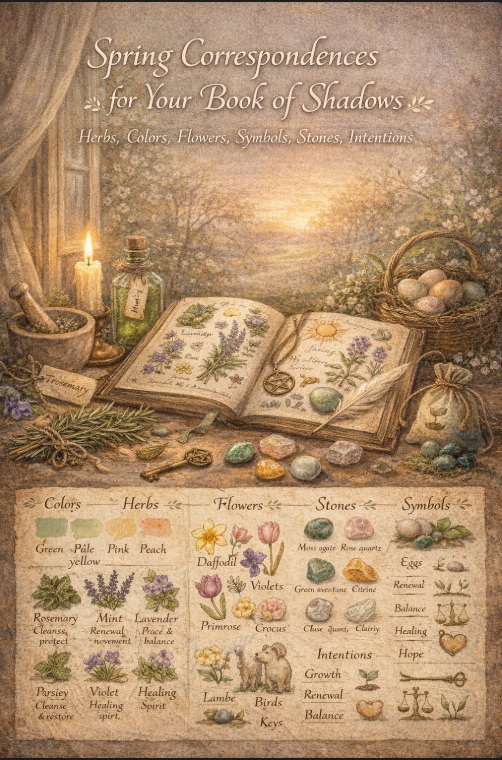
Spring Correspondences for Your Book of Shadows Herbs, colors, flowers, symbols, stones, and intentions for the season of renewal
Spring has a way of arriving in layers. First there is the shift in the light. Then the softening of the air. Then the first green things begin to appear, sometimes so quietly you almost miss them. It is a season of return, but not in a loud or hurried way. Spring does not burst in all at once. It wakes slowly, and in that slow waking there is a kind of magick all its own.
For many witches and spiritual practitioners, spring is a season of renewal, growth, fresh starts, balance, fertility, and hope. It is a beautiful time to refresh your altar, update your Book of Shadows, and gather the correspondences that feel true to this part of the year. Some of these are traditional, some are intuitive, and some may be deeply personal. That is part of the beauty of keeping a Book of Shadows in the first place. It becomes a living record of how the seasons speak to you.
Below is a simple but meaningful collection of spring correspondences you can use in your own practice, journaling, altar work, spellcraft, seasonal decorating, or quiet reflection.
The energy of spring
Before getting into the lists, it helps to pause and name the feeling of the season.
Spring carries the energy of:
awakening
renewal
fresh starts
fertility
hope
growth
balance
healing
movement
possibility
This is not quite the full abundance of summer. Spring is the first stirring. The first sign of life returning. The first little yes after a long no.
If winter is the inward season, spring is the season of emergence.
Spring colors
Color correspondences can be used in candles, altar cloths, ribbons, flowers, clothing, journal pages, spell bags, and seasonal decorations. Spring colors often reflect both the soft return of life and the brighter promise of what is to come.
Some traditional and intuitive spring colors include:
Green Growth, fertility, healing, abundance, renewal, new life
Gold The returning sun, vitality, blessing, sacred illumination
You do not need to use all of these. Even one or two colors can be enough to shift the feeling of a space and align your work with the season.
Spring herbs
Spring herbs tend to carry cleansing, protective, healing, and awakening qualities. Some are culinary, some are magickal, and many are both. Herbs can be used fresh or dried depending on your preference and availability.
Rosemary A wonderful herb for cleansing, remembrance, clarity, protection, and mental freshness. Rosemary is excellent in spring washes, bundles, altar bowls, and simple home blessings.
Mint Fresh energy, prosperity, movement, renewal, cooling, and clearing stagnant conditions. Mint feels like spring in herb form.
Lavender Peace, rest, beauty, emotional healing, gentle spiritual work, balance. Lavender is lovely for softening the nervous system after winter heaviness.
Thyme Courage, purification, vitality, strength, and resilience. Thyme has an old-world feel that sits beautifully in spring correspondences.
Basil Luck, abundance, prosperity, blessing, love, and freshness. Basil is one of those herbs that brings a lively, clean energy.
Parsley Renewal, cleansing, purification, protection, and health. Simple, common, and underrated.
Lemon balm Joy, ease, emotional soothing, uplift, restoration. Beautiful for spring after a difficult winter season.
Nettle Protection, strength, vitality, and healing. Nettle carries a wilder edge and reminds us that spring is not only delicate. It is powerful too.
Dill Luck, prosperity, protection, and growth. Dill carries a bright, living energy.
Sage Wisdom, purification, blessing, and spiritual clearing. If you use sage in your practice, spring is a natural time to work with it intentionally.
You might also choose herbs based on what is growing near you. Local plants often make the strongest seasonal allies.
Spring flowers
Flowers are one of the most obvious symbols of spring, but they also carry distinct energies. They can be placed on an altar, pressed into journals, woven into seasonal wreaths, offered to spirits, or simply enjoyed as living reminders of the season.
Daffodil Hope, rebirth, cheerful energy, return of life, confidence
Rose Love, beauty, blessing, sensuality, and spiritual devotion. Roses can belong to many seasons, but soft pink or white roses can fit beautifully into spring work.
Even if you do not have access to fresh flowers, images, pressed petals, or simple floral sketches in your Book of Shadows can hold the same feeling.
Spring stones and crystals
Crystals for spring often support growth, emotional clarity, healing, new beginnings, and balance. Choose the ones that feel alive in your hand. Spring is a tactile season. It wants to be felt.
Moss agate Growth, new beginnings, earth connection, stability, abundance. One of the best spring stones.
Green aventurine Luck, opportunity, prosperity, optimism, expansion
Rose quartz Self-love, tenderness, heart healing, emotional renewal
You do not need a large crystal collection to work seasonally. One stone placed on your altar, carried in your pocket, or tucked into a journal can be enough.
Spring symbols
Symbols are often the fastest way to create a seasonal feeling in your Book of Shadows. They can be drawn, painted, collaged, stitched, or simply noted as anchors for later use.
Some common spring symbols include:
eggs
nests
seeds
buds
sprouts
hares or rabbits
lambs
birds
feathers
bees
butterflies
Not every spring symbol has to be sweet or decorative. Spring is also mud, wind, unpredictability, cold mornings, and hard little shoots pushing through frozen ground. That belongs to the season too.
Spring intentions
One of the most useful parts of a seasonal correspondences page is the intentions section. This tells you what kind of work the season naturally supports.
Spring intentions may include:
renewal
balance
healing
hope
fertility
growth
new beginnings
prosperity
fresh energy
emotional clearing
inspiration
confidence
This is a very good season for spells and rituals around:
starting over
finding your footing again
clearing out old heaviness
blessing a new home or project
planting prosperity
encouraging love and beauty
supporting healing and hope
inviting life back into a stagnant situation
It is also a season for simple personal promises. Not grand vows. Just the kind that help you move with the light.
Ways to use these correspondences
Once you gather your spring correspondences, you can put them to work in simple, beautiful ways.
You might:
create a dedicated spring page in your Book of Shadows
make a seasonal altar with one flower, one herb, one stone, and one candle
choose a spring color palette for journaling or decorating
build a small charm bag for renewal or growth
write a spring prayer using the symbols that speak to you
refresh your home with herbs and open windows
press spring flowers into your journal
create a list of what you want to grow this season
pair a spring stone with a seasonal intention and carry it with you
This does not have to be complicated to be meaningful.
A gentle note on personal correspondences
One of the most important things to remember is that correspondences are guides, not rules.
If spring feels pale gold to one person and stormy silver to another, both can be true. If violets mean comfort to you because of a childhood memory, that matters. If rosemary always reminds you of your grandmother’s kitchen, that matters too. A living spiritual practice makes room for that kind of truth.
Your Book of Shadows should not just be a record of what other people say spring means. It should also become a record of what spring means to you.
What herbs do you reach for when the weather changes? What colors feel like return? What flowers stop you in your tracks? What kind of hope begins to stir in you when the light comes back?
Those are correspondences too.
Closing thoughts
Spring is a season of becoming. Not fully arrived, not fully formed, not yet in bloom, but moving unmistakably in that direction. There is something deeply sacred about that stage. The tenderness of it. The uncertainty of it. The quiet determination of it.
When you add spring correspondences to your Book of Shadows, you are doing more than making a list. You are creating a doorway into the season. A way to remember what this time of year feels like in your body, your home, your spirit, and your practice.
Use what speaks to you. Keep what feels alive. Let the season meet you where you are.
The earth does not rush into bloom, and neither do you need to.
Do you ever just feel spiritually “off.” Believe me, it happens! This is especially true if you have working towards one magickal goal for a long time. Every caster reaches a point where they do not want to light one more candle, say one more prayer, or scatter one more herb. The first feeling that usually follows is guilt. But there is no guilt to be had here! It is perfectly normal. I quite often tell people to take a break from their work.
People worry the spirits will think they stopped caring. They worry they have lost their connection. They worry something is wrong with them. Most of the time, nothing is wrong. Sometimes your spirit is not empty. It is full. Too full! You just don’t have room for one more thing.
Magick requires emotional movement. Intention requires focus. Connection requires attention. When life has been heavy, your mind quietly protects you by refusing to reach outward again.
So here is the strange advice. Do less on purpose. (If you are working a 9 day in a row spellcasting, you will have to just buck up!) But all other work, dolls, candles, charms, etc., you can take a small break.
Sit near your altar without working. Speak casually instead of formally. Skip a day without apologizing. Let the relationship exist without effort. A healthy spiritual connection is not powered by constant activity. It breathes like any relationship does. Sometimes close. Sometimes quiet. Just sitting and talking to your favorite spirit, without asking for anything, without you being required to do anything, can be so spiritually replenishing. It’s great to even tell your favorite spirit that you are feeling spiritually fatigued. They will understand.
If you do not feel like doing work, you are not failing the spirits. You are resting inside the connection instead of trying to prove it.