Category: Special Lwa Days

  • St. Joseph and Papa Loko!

    St. Joseph and Papa Loko

    Papaloko  Greetings, everyone!  Right on the heels of St. Patrick's Day is a day that doesn't receive quite as much recognition in most circles!  It is St. Joseph's Day and it is always celebrated on March 19. 

    In Vodou/Voodoo, St. Joseph is syncretized with the powerful and wise lwa Papa Loko.  Papa Loko is the giver of the asson (sacred rattle used by Mambos and Houngans) in the ritual of initiation.   Papa Loko is considered the father of all Vodou houses and is known to be the first Houngan.

    Papa Loko is also a healer and often gives herbal cures and medicinal root work knowledge to Houngans and Mambos.  This knowledge, especially in Haiti is used to help the Mambo or Houngan to offer medical help to members of the house.  Of course this practice isn't as widespread in the United States, but in Haiti, the head of a Vodou house often turns to Papa Loko to cure both serious and simple illnesses.

    St_joseph_alter_3Of all the Saint syncretizations, I think that the altars built to St. Joseph most closely resemble Vodou!  As you can see from this picture, the altars are extremely elaborate!  And as Vodouisants, I am sure you are going, "wow, that is some Voodoo altar!!"

    Building these altars has a rich tradition, especially in New Orleans history.  St. Joseph altars begin to be built several days ahead of time and are just beautiful.  Almost all of the food is given to the poor after the altar is torn down.

    The tradition of these altars originated in Sicily where St. Joseph was petitioned during a drought and famine.  The drought and famine broke and the people rejoiced and promised to always help feed the less fortunate.   As Vodouisants, we also take the opportunity of this day to do something for those less fortunate and dedicate it to both St. Joseph and Papa Loko!!

    Here is a link to a great article to read more about St. Joseph Day and how it is traditionally celebrated.  If you are not familiar with it, it is a fascinating read! (The author even mentions the Vodou connection!)

    Louisiana Project – St. Joseph's Day Altars

    This is a really cool link!  It is a virtual St. Joseph's Altar.  They even have a place for you to make a virtual offering to the altar!! (The altar might be closed today because the Vatican actually moved the feast day this year because of the way Holy Week fell on the Christian calendear, but normally this would be the feast day and, in my opinion, still is!)    😉

    Virtual St. Joseph Altar

    Honoring Papa Loko:  Obviously, for Vodouisants, St. Joseph Day is also an honor to Papa Loko.  Papa Loko is most often honored by Houngans and Mambos and there are even some schools of thought that if you are not a priest or priestess, you might not want to serve him as he reserves most of his guidance for them.  However, I do not feel there is any reason for non-initiates NOT to honor Papa Loko!  He may guide you towards initiation or have other important guidance for you. 

    His colors are yellow, white, and green.  You may serve him with almost any herb or leafy plant (think about serving him a green salad) and fresh water.  I have also found him to be fond of those green herbal drinks and green tea!

    It is a tradition in New Orleans Voodoo that if you want to know someone's secrets you take a small cloth bag, put some leaves in it that you are offering to Papa Loko (especially if you have built him a small altar and are doing service to him – take some of the leaves that you offered on the altar and put them in the small cloth bag).  Now write the person's name on a piece of paper nine times.  Fold it up and put it in the bag.   Take the bag and hang it in a tree where it is least likely to be disturbed for 99 days.  During those 99 days, that person's secrets are said to be all revealed to you.  The bag should continue to hang in the tree until it is destroyed by nature or disintegrates from age. 🙂

    Love, Mambo Sam

  • Fet Ghede/Ancestor service!

    Altarancestor

    If anyone would like to share images of their Fet Ghede/Ancestor service, we would love to see them! We may even share them (with permission and anonymity, of course!) in our next newsletter! If you would like to share, please send to Faith at customerservice@spellmaker.com  
    Ayibobo! 
  • Imbolc, Maman Brigitte, and St. Brigid – Oh My!

    Imbolc, Maman Brigitte, and St. Brigid – Oh My!

    Greetings one and all!

    As many of you may already know – tomorrow, February 2, is St. Brigid's day, Imbolc, Candlemas,
    and the Feast of St. Brigid.  To Vodouisants, Catholics, Pagans, and more, this is a wonderful day anticipating spring, looking for new love, and being ready to shed off the cold of winter.

    A popular prayer for this day is:

    "Blessed be the earth, and all who dwell upon it.

    We give thanks for the season now departing from us,
    For the blessings it has bestowed upon us,
    And upon those with whom we share this world.

    Blessed be the new season.
    We pray that it will be a time filled with peace,
    With abundance, with prosperity,
    With wisdom,
    With love."

    For Vodouisants, tonight, the eve of  St. Brigid's Day, is when we put a piece of clothing outside for Maman Brigitte to bless with her healing powers.  Take any piece of clothing, or even a scarf to tie your head with, and put it outside tonight.  Ask Maman Brigitte to walk your way tonight and bless that piece of clothing.  Light a small fire outside for a little while, even if you just burn a candle. Before you go to bed, burn the veve of Maman Brigitte in the fire. Then put that fire or candle out.  Make sure the wax is smoothed down  or that the ashes are smoothed down if you lit a small fire.  Any kind of mark or disturbance of the wax or ashes the next day is considered a sign that Maman was there and blessed your piece of clothing!

    Now you can wear that piece of clothing any time you aren't feeling well or you doing healing work or healing prayers for someone else.


    Veve for Maman BrigitteVevemamanbrigitte


    In Service, 

    Mambo Sam 

  • Happy Fet Ghede!

    Barontarot

    Hello everyone,

    As many have asked, here is some information about how to serve on Fet Ghede.

    To clear up some information – The Ghede (of which there are purported to be MILLIONS) are NOT the Baron and Maman Brigitte.  The Baron and Brigitte are considered the Mother and Father of the Ghede.  There is also a line of thought that the Baron and Brigitte are the "landowners" of the residence of the Ghede (the graveyard, of course).  :-)
     
    Traditionally, especially in New Orleans Voodoo, The Baron and Maman Brigitte are often served during Fet Ghede, too, but more as a show of respect. My point here, of course, is to make sure you know who you are serving!  If you are serving the Ghede, you are not necessarily serving The Baron and Brigitte and vice versa.
     
    As to service:  If at all possible, you should go to a cemetery on this day.  If you are not in a town where you have ancestors buried, then go to the cemetery anyway.  Bring a trash bag, gloves (if you want to not get your hands dirty),  flowers (purple ones are best if you can find some), and candy offerings, anything you like.  I like to find a grave that looks like it hasn't been attended to in years!  Clean up as best you can around the grave, pick up any trash or debris.  If you can, stay awhile – ask Papa Legba to open the gate to the Ghede and ask your ancestors to visit this spot, to talk to you, to guide you.  There is no real right or wrong way to do this — go to the graveyard and let yourself be led to what you should do and where you should go.
     
    I know people always get nervous about going to the graveyard — what if someone sees you?  What if someone asks you what you are doing?  As long as you aren't desecrating anyone's grave, it is okay for you to be there.  It is extremely rare for anyone to be questioned in a graveyard; I have probably spent more time there than any one of us, and I have never, ever been questioned or even paid attention to.  If you just look like you belong there and are doing something positive (flowers, cleaning) you are unlikely to draw much attention, especially this time of year!
     
    Even if you can't go to the graveyard, doing an altar to the Ghede is fun this time of year – you can get lots of cheap plastic skeletons and coffins and such.  Colors are purple, black, and white.  Offerings are rum, 21 peppers steeped in rum (be careful with this stuff — wear gloves to put the peppers in the rum bottle), unfiltered cigarettes, and roasted peanuts (raw peanuts, taken out of the shell, and stir fried in a skillet or roasted in the oven – NO SALT!! – remember – no salt in any offerings to the Ghede).  If you have ancestors you are serving at this time, put their favorite foods, their pictures, items to represent them on your altar.  St. Gerard, who is often used to represent the Baron, is also used to represent the Ghede in most Voodoo traditions.
     
    Once you are satisfied with your altar, light your candles and ask Papa Legba to open the gate to the Ghede and your ancestors.  This is a perfect time to ask your ancestors for their help, guidance, and favor.  If you have ancestors that you were particularly close to, ask them for their help with whatever situation you have that is troubling you.  Listen carefully, sometimes you might even hear them whisper to you!!  I always recommend that you do a bit of journaling in front of your altar:  Ask questions of the Ghede and your ancestors and write down the first thing that pops into your head – don't edit – write in stream of consciousness.  Don't re-read it right now.  Put it away at the end of the service and read it about a week later.   Sometimes you will be very surprised at what you see written there!
     
    Remember as well that Fet Ghede is celebrated as a sort of "New Year's" celebration – a new beginning where old problems and challenges are "buried" or solved!
     
    Have fun!
    Love,
    Mambo Samantha Corfield

  • Erzulie Freda! By Mambo Sam

    Erzulie Freda

    Image of Erzulie Freda Dahomey by Saundra Elise Ziyatdinov.  

    Erzulie Freda is the Vodou and New Orleans Voodoo goddess of love. A gracious, luxurious, and refined lwa (Vodou Spirit), Erzulie epitomizes femininity, love, passion, and is called upon for favors regarding one's love affairs. However, Erzulie Freda is love of every kind; she is not limited to romance. She is often misrepresented as petulant and never being able to be satisfied. This does a gross injustice to this beautiful spirit. The fact that she often dissolves into tears is misinterpreted as her being dissatisified with what is given to her. That is not it at all; she dissolves into tears because she knows that no amount of material wealth can make up for the lack of love and spirituality in one's life. So even though she is often served in luxury, upon appearance at Vodou rituals, she is often wracked with tears eventually. It is important to remember, also, that she cries so that you won't have to. Another misrepresentation of Erzulie is that she is flighty and unable to stay with one man. This misinformation comes from the knowledge of her three marriages; once to Ogoun, once to Agwe, and once to Papa Legba (a belief in our New Orleans tradition; in Haitian tradition her third husband is Damballah). The three gold rings that most Erzulie altars have on them represent these three marriages. However, we must remember that these three marriages probably took place over lifetimes. It is sometimes hard for us to conceive of the many lives of the lwa and how long they have been with us!  

    Serving Erzulie Freda

    As with most lwa, she is a complex spirit having lived many lifetimes to evolve to her present state. She, of course, has happy, wonderful, flirty appearances, also. She does love refined things and wants to drink the finest champagne and eat the finest foods (especially delicious sweets and chocolates). She loves frilly, girly things and dresses in beautiful clothes of silk and lace. She loves diamonds and gold..anything that represents wealth and finery! She knows these things do not make up for the sorrows of life, but enjoying these things eases the pain for many of us! Erzulie is no different!

    Many people are afraid to do service to Erzulie Freda if they don't have much money. That is such an injustice to her! Yes, she loves refined and expensive things; that is not in question. However, just because you don't have a lot of money does not mean you should not serve her. We are firm believers that any service done with a good heart and doing the best you can will be well received. 
     

    Luxury can be a state of mind and an environment can be luxurious without being expensive. So first start thinking of the space that you will be doing your service in. If you purchased the one-day ritual kit or plan on doing the ritual as written on the website make whatever area you will be doing your service in as lovely as you can! Even if you temporarily use one of your own bed sheets as an altar cloth, that is okay because you can spray your perfume on it and make it something special. Set the mood for the ritual with any candles you have and put on romantic music or tune your radio to a soft rock or other type of station that plays the kind of music that would set the mood for romance. Do you have jewelry? You can put it on the altar and "give" it to Erzulie! That doesn't mean you can't wear it! Of course you can, but if you dedicate it to her, then you have given her something wonderful. Do you have old magazines lying around? Cut out pictures of beautiful things – jewelry, clothes, perfume, etc. Make a simple collage out of them and put them on your altar for her!

    In Service, 

    Mambo Sam

  • Cousin Azacca!

    Azacca


    Hail to our dear Cousin Azacca (Azaka, Azaca)!

    Sometimes considered one of the simplest lwa, he brings a good nature and warmth into life. He is syncretized with the Catholic saint, St. Isidore the Laborer, sometimes called St. Isidore the Farmer. This is not be be confused with St. Isidore of Seville — this is a different person altogether! This makes perfect sense as St. Isidore was a simple farmer, and his feast day is May 15! 

    Since Azacca is one to make all things grow, this May feast day is a perfect time to honor him. He is such a good natured and easy going lwa, he is always considered one of the family, hence the "cousin" moniker. He is, of course, the lwa of agriculture, farming, all things to do with planting and growing. He is a wonderfully hard worker, a peasant, nothing sophisticated about him. I always consider Azacca sort of an everyman. He loves good profit, good girls, and good food! 

    He doesn't care much for "city folks" and is extremely down to earth and doesn't mind getting his hands dirty with honest work. He will have little to do with anyone with a pompous or condescending attitude. Azacca appears barefooted, in denim overalls, carries a straw bag, wears a big straw hat, and is rarely seen without his pipe and smoking tobacco.  He should serve as a reminder of our roots and our dependency on this earth for our very survival!  He is the ultimate conservationist living off the gifts of nature.

    He loves a good song and has a penchant for the being the town gossip. He is often the quiet observer, taking in all the doings around him, saving the knowledge for later when he can use it to his best advantage. Azacca knows who is who in the zoo! He generally will have all the info on who is dating whom, who is trying to swindle whom, and all the details that people sometimes try to hide! When possessing someone, it is not unusual to have him start telling everyone's secrets! Luckily for those who have something to hide, his voice is gravely and rough and he is somewhat hard to understand.  However, if you suspect someone is keeping a secret from you, do a service to Azacca and ask him to reveal that secret to you and watch what happens.

    He can, however, be very suspicious and does not always seem to want to give his favors easily. If you motivation for calling upon him is less than honest, he may refuse you.  However, usually he can be won over with some white rum and a plate of boiled corn. For the most part, he is a good-natured lwa. He is entertaining when he appears at ceremonies, singing you songs about how he would he would rather take charity than steal, all the while "stealing" everything he can get his hands own, usually while he is dancing in his unique fashion! These things are then returned to the distracted owners with everyone having a good laugh at his humorous antics.

    He usually will be found in a corner of any party where there is food, voraciously eating his food, looking with suspicion at anyone who might eye his plate. He is a greedy eater and drinker with little in the way of table manners. But this is easily forgiven because of his good nature and good humor.

    He is also is generally seen as the brother of Ghede. Author Bob Corbert writes, "There are interesting similarities between the sophisticated Ghede and the more bumbling Azacca, as though a younger less sophisticated brother were imitating a more secure older brother. Like Ghede, Zaka loves his food. But, unlike Ghede, he is rude and voracious in his eating habits, often running away to hide with him food and eat it quickly."

    As the lwa of agriculture and plant life, it is natural that Azacca is also an herbal healer. He is said to carry his healing herbs in his djakout (a straw shoulder bag) and is often called upon when there is sickness in a family. In Louisiana, animal fat candles are burned for him and bread is offered to him when someone is ill.  He is said to sop up the illness with the bread from the melted fat from the candles and eat it, thus curing the patient! 

    We here at Spellmaker.com call upon Azacca in many ways. We call upon him to "grow" things for us, even though they may not be considered the usual way to call on our Cousin! We call upon him to grow love between two people, to help people "grow" their finances, etc. He has always responded well to these petitions and we certainly can suggest that it is a wonderful way to broaden this powerful lwa's scope in your life! Look at your goals from the perspective of wanting them to grow to be big, beautiful plants and call upon Azacca to help you make that happen. 

    Of course, it probably goes without saying that he is also particularly wonderful to call upon if you are planting this spring. Pour a little rum into the ground around your garden and ask Azacca to help that garden grow! We make a mixture of corn and boiled peanuts and spread it around our garden for him. We just leave it there to mix with the soil and help the plants grow better.

    No matter what you are trying to grow in your life, May 15 is the perfect day to offer a feast to Azacca! Set up a small altar using his colors and offerings: A piece of denim makes the perfect altar cloth for him, yellow and green candles, a container of dirt, small gardening tools, etc. Spend some time thinking of what plants need nurturing in your life garden and ask Azacca to nourish them and help them grow! Ask him to renew and rejuvenate any wilting plants and cut out all the weeds!

    Azacca Stats: 
    Feast Day: May 15
    Saint Syncretization: St. Isidore the Farmer
    Colors: Green, yellow, brown – earthy colors.
    Foods: Avocados, corn, peanuts, beans and rice, strong coffee that is highly sweetened with sugar, yams, sugar cane and cane syrup (pour it all over his food and he will love you for it!), heavy breads, coconuts and coconut candy.
    Drink: Light or white rum (kleren).
    Offerings: The above food and drink, a straw bag, a straw hat, pipe with pipe tobacco, small gardening tools. We usually put a container of rich earth, something like nice potting soil, on an altar to him. Later on, put that dirt in your garden!  Azacca and your plants will reward you.

    In Service, 

    Mambo Samantha Corfield 

  • Papa Legba!


    PAPA LEGBA

    Legbaveve

    Article by Mambo Samantha Corfield

    Our dear Papa Legba (Papa Alegba in New Orleans Voodoo) is probably one of the most popular lwa (Vodou spirits) ever.  His ability to open doors, smooth roads, and in general help us get things done is legendary!  He can create possibilities, help you choose the right path in your life, and bring order to chaos!  Personally, I call on him whenever I am lost (which is often, I have no sense of direction) and even when I need a parking space.  🙂

    While he has many aspects or "personalities", his major function in both Haitian Vodou and New Orleans Voodoo, is to be the intermediary between the other lwa and humanity. His presence at the spiritual crossroads will give or deny permission to speak and interact the lwa. (Although I have to say,  I don't really recall him ever denying permission, though I suppose he would if he felt it was necessary!)  He is invoked in spell work and ritual using many analogies:  To open the gate, to open the door, to lift the veil, etc., between our human world and the spiritual world. He is always the first and last spirit invoked in any ceremony, because his permission is needed for communication between us and the lwa.  He opens and closes the doorway. 

    One of his most remarkable traits is that he is known to speak, understand, and translate all languages.  Through him you may speak to the lwa in any language.  If the lwa you are speaking to doesn't understand your language, Papa Legba will translate for you!  Just ask him!

    Papa Legba can also facilitate communication between yourself and someone with whom you are having difficulties being understood.  Let's say that you are using, for instance, our Red Male Image Candle kit to communicate some loving ideas to "Johnny".   Now you know Johnny pretty darned well and know that he doesn't always accept new ideas readily.  Simply call on Papa Legba to "translate" your petition words into words that Johnny will understand.  Calling on Papa Legba for a task like this is extremely easy.  Just talk to him:  "Papa Alegba, please translate for me.  Help Johnny understand what I want him to understand."   It is just that simple.  You don't have to even be extremely clear in what you need from Papa Alegba.  After all he is the "universal translator" – he KNOWS what you are talking about even if you aren't quite sure.

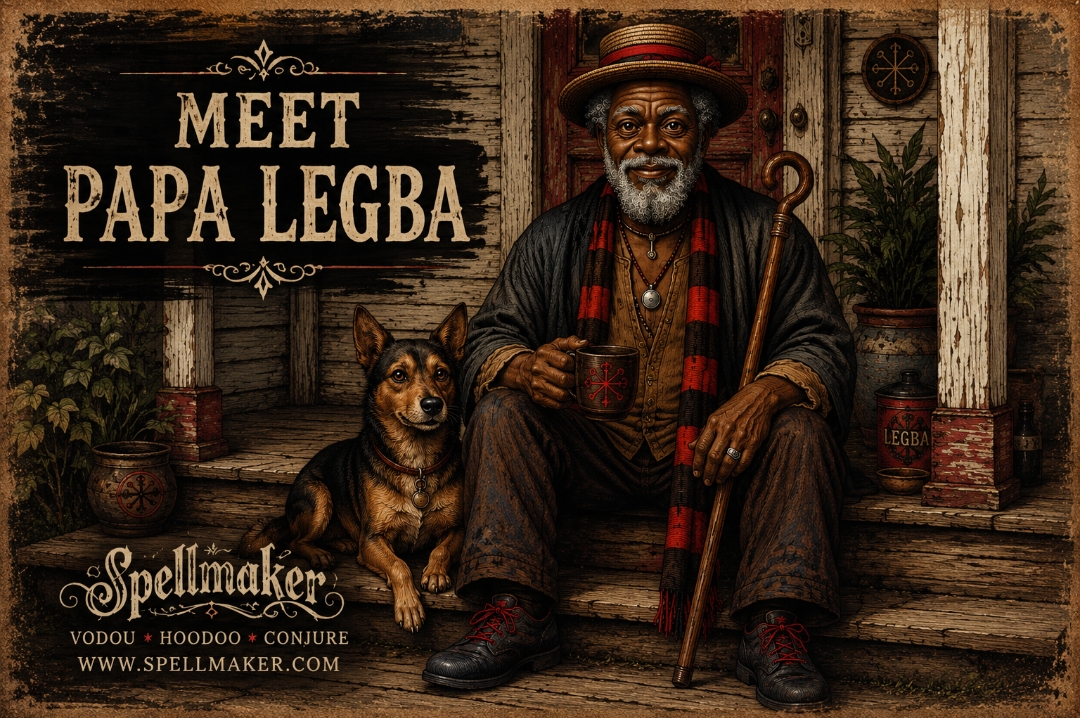
    He is such a fun character:  Often portrayed as a kindly old man, he is funny, loving, silly, and known to be a trickster.  Some people believe that he purposely plays tricks on people malvolently.  I have never found this to be true of those who serve him and those who call on him for help!  Perhaps some of his "tricks" are misinterpreted.  I believe, however, that many times people think something is attributed to Legba that wasn't him at all, but just happenstance.  At any rate, he is extremely helpful and powerful in Vodou magick and in all my years of working with him, he has never played any kind of trick on me that was mean or hateful. 

    Papa loves certain items that you should have if you desire to serve him:   A crutch or baton or walking cane; three pennies; a silver whistle (like coaches use); small toys; keys of any kind (don't throw your old keys away – give them to Papa); a straw knapsack or some kind of straw bag; a straw hat and, of course, a pipe with tobacco and a bottle of rum!  If you are setting up an altar for Papa, you want to have as many of these items as possible.  His altar cloth should be red and white or red and black or red/white/black.  He is traditionally served on Mondays.  Offerings can include rum, cigars, red beans and rice, plantains, smoked fish, chicken, and candy.  Haitian tradition includes goats and black roosters, but we aren't too likely to have those kinds of offerings here and he understands that – stick to the basics and he will be happy!  Dogs are sacred to him.  If you have a dog, s/he will usually show interest when you are calling upon Papa!  Many clients have told me that their dogs went a little bit crazy when Papa was called upon; a sure sign that he is around. 

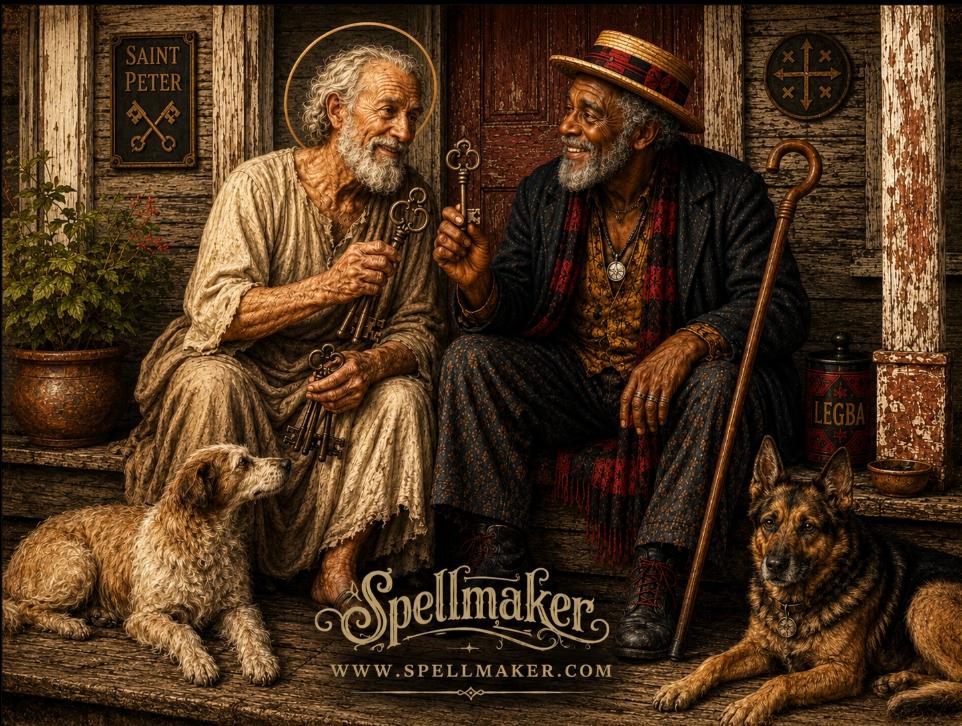
    In Africa, his counterpart, Eshu, is a god of prophecy and taught people how to interpret oracles and readings (corresponding with the "translator" aspect of Papa).  Often he will appear as an old man on a crutch or with a cane, wearing a broad brimmed straw hat and smoking a pipe, or sprinkling water.  Because of his position as 'gate-keeper' between the worlds of the living and Les Mysteres he is often identified with Saint Peter who holds a comparable position in Catholic tradition and, of course, is depicted holding keys. . But he is also depicted in Haiti and New Orleans as St. Lazarus, or St Anthony of Padua. Using Catholic Saint candles to honor Papa Alegba is perfectly acceptable.  

    So, however you serve Papa, doing so is always a rewarding and fun experience.  Try it!