Category: Angels and Other Beings of Light

  • St. Gertrude of Nivelles: The Patron Saint of Cats

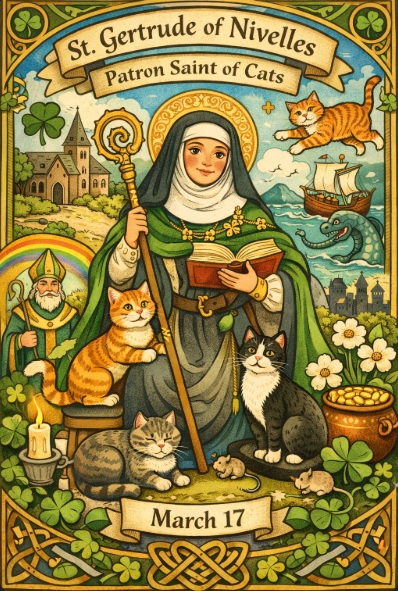
    St. Gertrude of Nivelles: The Patron Saint of Cats

    Every year on March 17, the world turns green. People gather for parades, Irish music, good food, and a toast or two in honor of St. Patrick, the patron saint of Ireland. Shamrocks appear everywhere, stories of saints and serpents are told, and the day takes on that cheerful, celebratory feeling that comes with the first hints of spring.

    But St. Patrick is not the only holy figure connected with March 17.

    The same day is also the feast day of St. Gertrude of Nivelles, a lesser-known saint from the early Middle Ages who has quietly earned a reputation among animal lovers as the unofficial patron saint of cats.

    While the Vatican has never formally declared her the patron saint of felines, folklore, history, and a good deal of medieval artwork have firmly connected her with our whiskered companions.

    And once you hear the story, it makes a surprising amount of sense.

    St. Gertrude was born in the year 626 in the town of Nivelles, in what is now modern-day Belgium. She came from a wealthy and influential family during the Merovingian period of European history. Even as a child, Gertrude showed a strong desire for religious life.

    This led to a dramatic moment when she was only about ten years old.

    At a banquet held by her father, a nobleman asked that Gertrude be promised in marriage to the son of a duke. Such arrangements were common among noble families at the time, often made to strengthen alliances and social standing.

    But Gertrude shocked everyone present by firmly refusing.

    She declared that she would marry no earthly man and that Christ would be her bridegroom. It was an unusually bold statement for a young girl in the seventh century, but it set the course for the rest of her life.

    A few years later, Gertrude’s mother founded a monastery at Nivelles. Interestingly, it was a double monastery, meaning it housed both monks and nuns, something that was not unheard of in early medieval Europe but still relatively rare.

    After her mother’s death, Gertrude eventually became the abbess of the community.

    She was known for her deep devotion to prayer, her learning, and her hospitality toward travelers and pilgrims who passed through the region. In an era when long journeys were dangerous and difficult, monasteries often served as places of refuge. Gertrude welcomed visitors generously, and over time she became known as a protector of travelers and pilgrims.

    Her dedication to spiritual life, however, was intense.

    Like many saints of the early church, she practiced strict asceticism. She fasted frequently, slept very little, and devoted long hours to prayer. These practices gradually weakened her health. By the time she was thirty-two years old, she had become too ill to continue serving as abbess and stepped down from the role.

    She died not long afterward, on March 17 in the year 659, at the age of thirty-three.

    Almost immediately after her death, people began honoring her as a saint. Stories circulated of miracles attributed to her prayers and protection. She was said to have saved her monastery from fire, restored sight to the blind, revived a drowned child, and protected travelers in dangerous situations.

    One medieval legend even tells of sailors who prayed to St. Gertrude during a storm at sea when a giant sea creature rose from the water and threatened their ship. After they called upon her for help, the creature vanished and the sailors reached shore safely.

    Because of stories like this, medieval travelers sometimes toasted St. Gertrude before beginning a journey.

    Over time, she became associated with a wide range of patronages, including pilgrims, gardeners, widows, and those suffering from illness or fever.

    But the story of how she became linked to cats begins with something much smaller.

    Mice.

    In late medieval artwork, St. Gertrude often appears holding an abbess’s staff while mice run at her feet or climb along the crozier. At first glance it seems like a strange detail, but there are several explanations.

    One theory comes from medieval symbolism. In parts of the Netherlands, mice were sometimes used to represent souls in Purgatory, the place where Catholics believed souls were purified before entering heaven. Because Gertrude was known for praying constantly for the souls of the departed, the mice may have symbolized the spirits she interceded for.

    Another explanation is far more practical.

    According to legend, the monastery at Nivelles once suffered from a serious mouse infestation that threatened their grain stores. Gertrude prayed for relief, and the mice disappeared. After her death, people began invoking her protection against rats and mice, which were major threats to food supplies in medieval communities.

    And where there are mice, there are usually cats.

    Monasteries across Europe commonly kept cats to protect grain stores, manuscripts, and kitchens from rodents. Cats were valued working animals, quiet guardians of the pantry and library.

    So if St. Gertrude protected homes and monasteries from mice, it was only natural that her reputation would extend to the animals who helped control them.

    By the late Middle Ages, the connection between St. Gertrude and cats had become firmly rooted in folklore.

    In modern times, the idea gained renewed attention when a 1981 publication from the Metropolitan Museum of Art referred to St. Gertrude of Nivelles as the patron saint of cats. The title quickly caught on, especially among cat lovers who were delighted to discover that their favorite animals had a saintly advocate.

    Today, while her patronage of cats remains unofficial, St. Gertrude is widely celebrated as their gentle protector.

    So the next time March 17 arrives and the world fills with shamrocks and St. Patrick’s Day celebrations, it may be worth remembering that another saint shares the day.

    St. Gertrude of Nivelles, the quiet abbess of a seventh-century monastery, left behind a legacy of hospitality, prayer, and care for the small creatures who shared her world.

    And for anyone who lives with a cat curled beside them on a chair, windowsill, or altar, that connection feels surprisingly fitting.

    After all, homes guarded by cats have always had a certain kind of magic. 🐈🍀

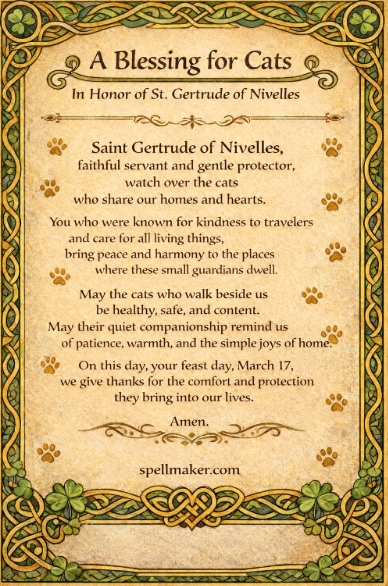
    Please print out and enjoy this prayer card for St. Gertrude! Hold it between your hands while praying, place it near a photo of your beloved feline or near their bed if they might be under the weather.
  • The Black Dog of Hogmany!

    Screenshot_30-12-2024_131435_chatgpt.com

    If you know me at all, you know I love a good black dog story….As the cold winds of December sweep across the Scottish Highlands, they carry whispers of folklore, mystery, and tradition. Among the many tales woven into the fabric of Scotland’s rich culture, the story of the Black Dog of Hogmanay holds a special place. It’s a tale that seems to rise up from the misty hills and quiet glens, cloaked in the magic of the season and the timeless mystery of the unknown.

    Hogmanay, Scotland’s New Year celebration, is not just an occasion of revelry and fireworks; it is a deeply symbolic moment—a time of endings and beginnings, of looking back at the past and forward into the future. For centuries, traditions surrounding Hogmanay have been as varied and colorful as the tartans of the clans themselves, but the Black Dog remains a haunting figure in this tapestry of customs.

    The Black Dog, in Scottish folklore, often takes on the role of a guardian, an omen, or even a harbinger of change. Seen as both mystical and mysterious, it is a figure that treads the fine line between worlds—the past and the future, the known and the unknown. As the clock strikes midnight on Hogmanay, when the veil between the old year and the new is thinnest, the Black Dog is said to appear, silently watching, quietly waiting.

    The stories tell us that this spectral canine often roams the darkened paths and quiet fields as families gather indoors, exchanging gifts and sharing first-footing traditions. For those unfamiliar, first-footing is a cherished Hogmanay custom where the first visitor to cross the threshold after midnight brings good luck to the household. The Black Dog, however, is no ordinary visitor. It is said to come unbidden, padding silently through the icy night, its glowing eyes reflecting the light of the stars, its presence both a comfort and a warning.

    To some, the Black Dog represents protection. It is believed to guard homes against misfortune, standing sentinel at the door to ensure that no ill will enters with the new year. Families who sense the presence of the Black Dog speak of a feeling of safety, of being watched over by a loyal guardian from another realm. To others, however, the Black Dog carries an air of foreboding—a reminder of the unknown and the unpredictable nature of what lies ahead.

    The duality of the Black Dog reflects the very essence of Hogmanay itself. It is a celebration of hope and renewal, but also a recognition of the challenges and uncertainties that come with a fresh start. The Black Dog reminds us to tread carefully as we step into the unknown, but also to trust in the journey ahead.

    In the quiet villages of Scotland, stories of the Black Dog have been passed down through generations, told by the fireside as families prepare for the year to come. It is said that if you encounter the Black Dog on Hogmanay, you must pause and take stock of your intentions for the future. Are you carrying unresolved grudges or fears that no longer serve you? Are you ready to welcome the possibilities of the new year with open arms? The Black Dog sees all, they say, and its presence is a reminder to act with integrity and courage.

    For those who celebrate Hogmanay today, the Black Dog may no longer roam the countryside as it once did in the tales of old, but its spirit lingers in the rituals and traditions that mark the occasion. Lighting a candle in the window to guide loved ones home, sharing a meal of symbolic foods like black bun or shortbread, or even simply stepping outside to take in the cold night air—these moments are steeped in the same magic that once surrounded the Black Dog.

    As midnight approaches and the bells begin to ring, one can almost imagine the shadow of a great dog slipping silently through the streets, unseen by most but felt by all. It is a moment of transition, a threshold between what was and what will be, and the Black Dog is its silent witness. Whether you see the Black Dog as a guardian, a guide, or simply a legend from a time long past, its story serves as a powerful reminder of the magic that exists in every ending and beginning.

    So, this Hogmanay, as you raise a glass to the new year and whisper your hopes into the midnight sky, take a moment to honor the Black Dog and all that it represents. In its shadow lies the beauty of change, the strength of resilience, and the promise of a fresh start. After all, what better way to welcome a new year than with the courage to embrace both its mystery and its magic?

    Love, Sister Bridget 

  • Saint Roch Patron Saint of Dogs!

    Saint Roch
    Patron Saint of Dogs
    Feast Day August 16th. 

    The story of how St. Roch became the patron saint of dogs is a tale rooted in compassion, selflessness, and a deep connection with both humans and animals. St. Roch, also known as San Rocco or Saint Roche, lived during the 14th century in Montpellier, France.

    Roch was born into a noble family and was orphaned at a young age. He inherited a considerable fortune and chose to dedicate his life to serving those in need. When a plague swept through his town, Roch's heart went out to the suffering and he selflessly tended to the sick and dying, providing comfort and care to those who were abandoned by others.

    During his travels, Roch contracted the plague himself. He retreated to a nearby forest to isolate himself, so as not to spread the disease further. It's during this period of isolation that a miraculous event occurred, solidifying his connection to dogs and earning him the title of the patron saint of dogs.

    Legend has it that while Roch was in the forest, a dog belonging to a local lord discovered him and began bringing him food, licking his wounds, and providing companionship. This loyal dog, acting as a sort of guardian angel, sustained Roch throughout his illness and aided in his recovery. The dog's devotion and care were instrumental in saving Roch's life.

    When Roch finally recovered, he returned to his town to find it ravaged by the plague. He resumed his work of caring for the sick and healing the afflicted. His identity, however, remained concealed, as he did not want recognition for his noble actions.

    One day, as he was caring for ailing patients, Roch was arrested under suspicion of being a spy due to his concealed identity. He was imprisoned and eventually died in captivity. It was only after his death that his true identity was revealed, and the people of the town recognized him as a selfless servant of humanity.

    Roch's connection with dogs during his time of illness, along with his unwavering compassion for both humans and animals, led to his association with dogs as their patron saint. His story spread across different cultures, and over time, he became known as the protector and guardian of dogs, as well as someone to turn to for healing and protection against diseases.

    The veneration of St. Roch as the patron saint of dogs became especially prominent during times of disease outbreaks when people sought intercession for the health and well-being of their beloved pets. His feast day, August 16th, is celebrated by many communities around the world with blessings for dogs and other animals, as well as prayers for protection against illnesses.

    The story of St. Roch's journey from a compassionate caretaker of the sick to the patron saint of dogs exemplifies the profound impact that empathy and kindness can have on both humans and the animals we share our lives with.

  • Chief of the Guardian Angels!

    Barakial

    Barachiel is an archangel known as the angel of blessings and this angel is also the chief of all of the guardian angels. Barachiel (who is also often known as "Barakiel") means "God's blessings." Other spellings include Barchiel, Baraqiel, Barkiel, Barbiel, Barakel, Baraqel, Pachriel, and Varachiel.

    Barachiel intercedes in prayer before God for people in need, asking God to give them blessings in all areas of their lives, from their relationships with family and friends to their work. People ask for Barachiel's help in achieving success in their pursuits. Since Barachiel is also the chief of all guardian angels, people sometimes ask for Barachiel's help delivering a blessing through one of their personal guardian angels. 

    In art, Barachiel is usually depicted scattering rose petals that represent God's sweet blessings showering down on people, or holding a white rose (which also symbolizes blessings) to his chest. However, sometimes images of Barachiel show him holding either a basket that's overflowing with bread or a staff, both of which symbolize the blessings of producing children that God bestows on parents. 

    Barachiel sometimes appears in feminine form in paintings that emphasize Barachiel's nurturing work delivering blessings. Like all archangels, Barachiel doesn't have a specific gender and can manifest as either a male or a female, according to what works best in a given situation.

    Green is the angel color for Barachiel. It represents healing and prosperity and is also associated with Archangel Raphael.

    The Third Book of Enoch, an ancient Jewish text, describes archangel Barachiel as one of the angels who serve as great and honored angelic princes in heaven. The text mentions that Barachiel leads 496,000 other angels who work with him. Barachiel is part of the seraphim rank of angels who guard God's throne, as well as the leader of all the guardian angels who work with humans during their earthly lifetimes. 

    Barachiel is an official saint in the Eastern Orthodox Church, and he is also venerated as a saint by some members of the Roman Catholic Church. Catholic tradition says that Barachiel is the patron saint of marriage and family life. He may be shown carrying a book representing the Bible and Papal encyclicals that direct the faithful on how to conduct their marital and family life. He also traditionally has dominion over lightning and storms and also sees to the needs of converts.

    Barachiel is one of the few angels that made it into the Lutheran liturgical calendar.

    In astrology, Barachiel rules the planet Jupiter and is linked to the Pisces and Scorpio zodiacal signs. Barachiel is traditionally said to inspire a sense of humor in people who encounter God's blessings through him.

    Barachiel is mentioned in the Almadel of Solomon, a book dating from the Middle Ages on how to contact angels by means of a wax tablet. 

    Source:Learnreligions.com

  • The Archangel of Music!

    Sandalphon

    The Archangel Sandalphon is known as the angel of music. He rules over music in heaven and helps people on Earth use music to communicate with God in prayer. Sandalphon means "co-brother," which refers to Sandalphon's status as the spiritual brother of the archangel Metatron. The ending of -on indicates that he ascended to his position as an angel after first having lived a human life, believed by some to be the prophet Elijah, who ascended to heaven on a horse-drawn chariot of fire and light. Other spellings of his name include Sandalfon and Ophan (Hebrew for "wheel").

    Sandalphon also receives the prayers of people on Earth when they arrive in heaven, and he then weaves the prayers into spiritual flower garlands to present to God, according to the liturgy for the Jewish Feast of Tabernacles.

    People sometimes ask for Sandalphon's help to deliver their prayers and songs of praise to God, and to learn how to use their God-given talents to make the world a better place. Sandalphon is said to have lived on Earth as the prophet Elijah before ascending to heaven and becoming an archangel, just as his spiritual brother, Archangel Metatron, lived on Earth as the prophet Enoch before becoming a heavenly archangel. Some people also credit Sandalphon with leading the guardian angels; others say that Archangel Barachiel leads the guardian angels.

     In art, Sandalphon is often depicted playing music, to illustrate his role as the patron angel of music. Sometimes Sandalphon is also shown as an extremely tall figure since Jewish tradition says that the prophet Moses had a vision of heaven in which he saw Sandalphon, whom Moses described as being very tall.  The angel color of red is associated with Archangel Sandalphon. It is also associated with Archangel Uriel.

    Sandalphon rules one of the seven levels of heaven, according to religious texts, but they don't agree on which level. The ancient Jewish and Christian non-canonical Book of Enoch says that Sandalphon rules over the third heaven. The Islamic Hadith says that Sandalphon is in charge of the fourth heaven. The Zohar (a sacred text for Kabbalah) names the seventh heaven as the place where Sandalphon leads other angels. Sandalphon presides over the exit from the spheres of the Kabbalah's Tree of Life.

    Sandalphon is said to join the angelic armies that archangel Michael leads to fight Satan and his evil forces in the spiritual realm. Sandalphon is a leader among the seraphim class of angels, who surround God's throne in heaven.

    In astrology, Sandalphon is the angel in charge of planet Earth. Some people believe that Sandalphon helps differentiate the gender of children before they're born.

    Source: Learnreligios.com Feb. 8, 2021

  • St. Francis of Assisi Feast Day!

    Hello!

    Below is a short video about St. Francis. He is quite near and dear to our hearts hear at Spellmaker, due to our love of animals! The video is short but informative! I hope you enjoy it. 

    Love,

    Sister Bridget

    PS – Did you know St. Francis was canonized just TWO years after his passing? Now you do! 

    Fast Facts: St. Francis of Assisi

    • Known For: Patron saint of animals
    • Also Known As: Francesco (or Giovanni) di Pietro di Bernardone
    • Born: c. 1181 in Assisi, Italy
    • Parents: Pietro di Bernardone, Pica de Bourlemont
    • Died: Oct. 3, 1226 in Assisi, Italy
    • Notable Quote: "Start by doing what's necessary; then do what's possible; and suddenly you are doing the impossible."


    Prayer to Saint Francis of Assisi, for Our Pets:

    Good St. Francis, you loved all of God's creatures. To you they were your brothers and sisters. Help us to follow your example of treating every living thing with kindness. St. Francis, Patron Saint of animals, watch over my pet and keep my companion safe and healthy. Amen.


  • Feast of the Guardian Angels October 2nd!

    Feast of the Guardian Angels October 2nd

    From the moment we are born, each and every one of us has an Guardian Angel. Those of you reading this who were at the Albuquerque Voodoo Convention in 2007 each received some extra special knowledge about your guardian angel from Mambo Sam.

    Do something special today to thank your own guardian angel 😉 Bake an angel food cake, or some angel hair pasta, or some angel wing cookies. Acknowledge and thank you guardian angel! They are always on duty, keeping us safe from harm.

    Light and Love
    Sister Bridget

    10_2_guardian3

    Guardian angel prayer
    Guardian angel prayer


  • Saint Gabriel the Archangel~

    Saint Gabriel the Archangel~

    Gabriel-1


    Gabriel’s name means “God is my strength”.

    ~


    Gabriel helps people whose life purpose involves communication, including teachers, writers, actors, photographers, speakers, etc.

    ~


    This archangel is a messenger who whispers in our ear of coming events, changes, and opportunities for new experiences. Gabriel always brings good news !

    ~


    He restores life and light into stagnant areas of your life such as relationships, businesses, households, etc. Ask Gabriel to resurrect any blocked areas of your life and fill you with the remembrance of your divine purpose and destiny. You will receive creative ideas and opportunities to help you get moving again.

    ~


    Call on Gabriel for assistance with a career or a problem that involves putting forth your ideas and perceptions to others. Definitely ask Gabriel to be with you when you are going on a job interview or asking for a raise or promotion at work.

    ~


    Because of Gabriel's role as a communicator and mediator between Heaven and Earth, Catholics hold the Archangel to be a Patron Saint of broadcasters, telecommunications workers, diplomats, messengers, postal workers, and stamp collectors.

    ~


    Because Gabriel helped the prophet Daniel interpret his dreams, those seeking similar aid with their own dream work may petition the Archangel for help.

    ~

    Mentally call for Gabriel by saying, “Beloved Gabriel, please come to me now and help me express myself in the best Light. Thank you.”

    ~


    Correspondences:

    Gabriel’s colors are white and indigo

    Gabriel guards the day of Monday

    Gabriel is associated with the second (sacral) chakra

    Gabriel’s special number is nine.

    Crystals associated with Gabriel are Orange Calcite, Topaz, Moonstone, and pearls.

    Lillies are very special to Gabriel.


    Prayer to Saint Gabriel


    Blessed Saint Gabriel, Archangel

    We beseech thee to intercede for us at the throne of divine mercy:

    As thou didst announce to Mary the mystery of the Incarnation,

    so through thy prayers may we receive strength of faith and courage of spirit,

    and thus find favor with God and redemption through Christ Our Lord.

    May we sing the praise of God our Savior with the angels and saints in heaven forever and ever. Amen

    ~~~~~~~~~~~~~~~~~~~~~~~~~~~~~

    When a divine spirit grants your wish, it is customary, to give an offering of some kind in return. Because Archangel Gabriel, the Messenger of God, is generally depicted with white lilies or a trumpet horn, it is considered appropriate to make an offering of white flowers or to play music before an altar a thank-offering.

    "If you seek an angel with an open heart…

    You shall always find one."

    – Anonymous


  • Archangel Raphael!

    Archangel Raphael

    Rafael


    Raphael’s name means “God heals” or “God has healed” which tells us a lot about his responsibilities to Earth and her inhabitants. Raphael is a very powerful healer of both humans and animals. Raphael is very connected to all animals, both domestic and wild. He can be called to help find lost pets.

    ~


    Ask Raphael for help when you are in any kind of pain, whether it be physical, emotional romantic, intellectual or spiritual. He will somehow inspire you with sudden ideas and thoughts giving you just the right information to help the healing. Pay attention to and then follow these angelic answers to your prayers.

    ~


    You can call on Raphael on behalf of someone else who is in need of healing. He is also associated with the healing of addictions. The person must want the help, and be accepting of it for it to occur. Angels can not interfere with a person’s free will.

    ~


    When asked for healing assistance, Raphael surrounds and nurtures people with the emerald green light of his halo. Green is the color of healing and clairvoyant people may see emerald green sparkles when Raphael is around. 

    ~


    Raphael is connected to eyesight – both physical and non-physical. If you or a friend are going in for eye surgery, ask Raphael to oversee things. If you are needing help connecting with your intuition, he can help with that as well.

    ~


    Raphael oversees travelers, helping them arrive at their destination safely. Infact, he is the patron saint of travelers.

    ~


    Raphael is also very connected to doctors, nurses, and other health care workers.

    ~


    Raphael's loving personality outshines his physical characteristics; he is often described as being friendly, amusing, gentle and kind. These qualities also make him the Archangel best suited to overseeing the host of guardian angels.

    ~


    Correspondences:

    Green Aventurine is very special to him. Carry a small piece of this crystal in your pocket and hold it in your hand when you need to call on him. . Also other crystals such as emerald, jade and rose quartz are special to him.

    The Heart Chakra is specifically associated with Raphael.

    People often see flashes or sparkles of emerald-green light when calling on him.

    His colors are emerald green and deep pink – both colors of the heart.

    His special number is eight.~


    A prayer to Saint Raphael

    Blessed Saint Raphael, Archangel

    We beseech thee to help us in all our needs and trials of this life,

    as thou, through the power of God, didst restore sight and

    give guidance to young Tobit.

    We humbly seek thine aid and intercession,

    that our souls may be healed,

    our bodies protected from all ills,

    and that through divine grace we may be made fit

    to dwell in the eternal Glory of God in heaven. Amen.

    ~~~~~~~~~~~~~~~~~~~~~~~~~~~~~

    A prayer to  St. Raphael for  Before A Journey

    Dear Saint Raphael, Angel of travelers,

    be with me and guide me on this journey.

    Protect me from sickness and danger

    and guard those I leave behind.

    Let your wings enfold me

    while I am away and return me

    safely home.

    Amen.

    ~~~~~~~~~


    Another Prayer to Saint Raphael the  Archangel

    Glorious Archangel Saint Raphael, great prince of the heavenly court, you are illustrious for your gifts of wisdom and grace. You are a guide of those who journey by land or sea or air, consoler of the afflicted, and refuge of sinners. I beg you, assist me in all my needs and in all the sufferings of this life, as once you helped the young Tobias on his travels. Because you are the "medicine of God," I humbly pray you to heal the many infirmities of my soul and the ills that afflict my body. I especially ask of you the favor {mention your petition} and the great grace of purity of prepare me to be the temple of the Holy Spirit. Amen.