The Crone, the Keeper, and the Wisdom We Cannot Afford to Lose
Today is Crone Day, and if you have never heard of it, that is actually part of the point.
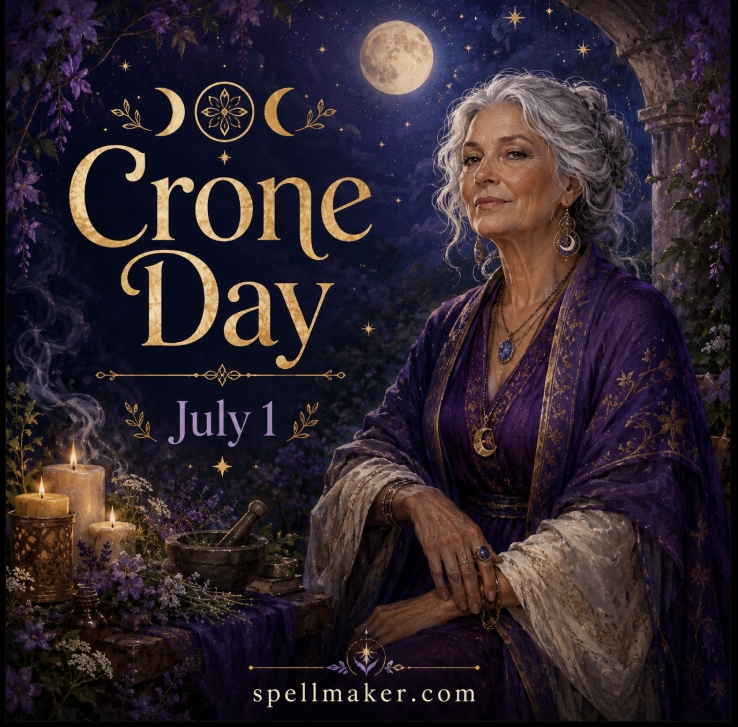
The Crone is the third face of the Triple Goddess — Maiden, Mother, Crone — and she is the one we talk about least, celebrate least, and too often overlook entirely. In a culture that worships youth and novelty, the Crone does not fit neatly into the packaging. She is old. She has lived through things. She does not soften her words to make you comfortable, and she has long since stopped apologizing for taking up space. She is, in many spiritual traditions, the most powerful of the three — the one who has crossed enough thresholds to know what actually matters and what does not.
Honoring the Crone today is not simply about honoring an archetype. It is about honoring the real, living women in your life who carry her energy — the ones who remember things nobody else remembers, who have survived losses that would have broken someone younger, who can look at a complicated situation and cut straight to the heart of it in a way that takes decades to learn. The grandmothers. The great aunts. The elder neighbors. The women in your family who are still here, still sharp, still full of something irreplaceable — and who will not always be.
There is a particular kind of wisdom that only comes from having lived a long time, and it cannot be googled. It cannot be downloaded or summarized in a short video. It lives in the body and the memory of a person who was actually there — who remembers what it felt like to navigate a world without the tools we now take for granted, who learned to read weather and people and situations through decades of quiet observation, who carries in her hands and her stories and her recipes and her prayers a kind of knowledge that is almost never written down anywhere.
This is what we mean when we talk about generational wisdom. It is not just information passed from one person to another. It is a living thread connecting us to everyone who came before — to the grandmothers and the great grandmothers and the women who stood in kitchens and fields and doorways long before any of us arrived. When that thread breaks, it does not always break loudly. Sometimes it just quietly disappears, and we do not notice until years later when we find ourselves wishing we had asked a question we can no longer ask.
That is the weight of today, if we let ourselves feel it.
Most of us have someone in our lives — or had someone, not so long ago — who carried this kind of wisdom. And most of us, if we are honest, did not ask nearly enough questions while we had the chance. We were busy. We assumed there was more time. We did not realize until too late that the stories and the knowledge and the particular way she said certain things were not going to be there forever. That loss is one of the quietest and most profound kinds there is.
Crone Day is an invitation to do something about that while you still can.
If there is an elder woman in your life — a grandmother, a great aunt, an older friend, a woman in your spiritual community who has been walking this path longer than you have — today is a beautiful day to reach out. Not with an agenda, not with a checklist of questions, but simply to be with her. To let her talk. To listen in a way that makes her feel that what she has lived and learned and carried actually matters to someone younger. Because it does. It matters more than most of us say out loud.
Ask her about something she is proud of. Ask her what she knows now that she wishes she had known at your age. Ask her about the old ways — the recipes, the remedies, the prayers, the superstitions that were passed to her by someone who is now gone. Write it down if she will let you. Record her voice if she is willing. These are not small things. These are the threads that keep us connected to something larger than ourselves, and they deserve to be preserved with the same care we give to anything sacred.
In our house, we know something about this. Mambo Sam carries wisdom that was passed to her by her grandmothers — Mattie Maude Parker and Grandma Angela — women who are gone now but whose knowledge lives on in everything this house does. That lineage is not just a nice story. It is the foundation. It is why we know what we know and do what we do. Every tradition, every spiritual house, every family has a version of this lineage, whether it is formally recognized or simply passed quietly through the generations in the way a woman holds her hands when she prays.
Honor your Crone today. Call her. Visit her. Sit with her long enough to really listen.
Before it is too late.
Ayibobo. 🔑
Sister Bridget