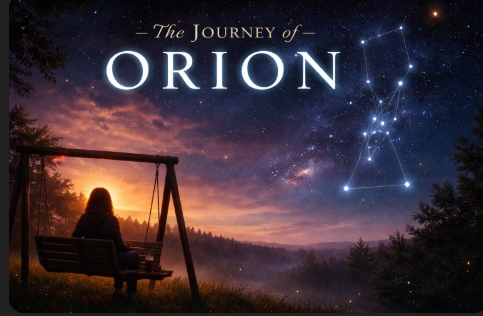
There’s a moment every year when you go outside, look up, and realize something is missing.
You don’t notice it right away. The sky still looks like the sky. There are still stars, still that familiar hush that settles in after sunset. But then it hits you.
Orion is gone.
If you’ve ever learned to recognize him — really recognize him — it feels strange. His three-star belt is so steady, so easy to find, that once you know it, you start to expect it. It becomes part of your sky. Part of your rhythm.
And then one night, he’s just… not there.
But here’s the thing. Orion doesn’t actually disappear.
He just moves on.
As the seasons shift, Orion drifts lower in the evening sky, setting earlier and earlier each night. By summer, he’s still above us, still whole, still exactly where he’s always been — but now he’s rising and setting with the Sun, hidden in the daylight where we can’t see him.
Nothing about him is broken. Nothing has been lost.
He’s simply stepped out of view.
And months later, if you’re paying attention, you’ll catch him again just before dawn. Quiet. Almost shy. That same familiar line of three stars rising in the early morning sky, like a memory returning.
By winter, he’s back where he belongs — standing tall, clear and unmistakable, as if he never left at all.
The sky teaches this lesson over and over, if we’re willing to watch it.
Not everything that leaves is gone. Not everything that disappears is lost.
Some things just move into a different part of the cycle, waiting for the right time to return.
So if there’s something in your life that feels like it’s slipped out of reach — a person, a feeling, a sense of direction — it might not be gone in the way it feels.
It may just be out of sight for now.
And like Orion, it may come back into view when the season shifts again.
Until then, the sky is still full. Still moving. Still holding more than we can see at once.
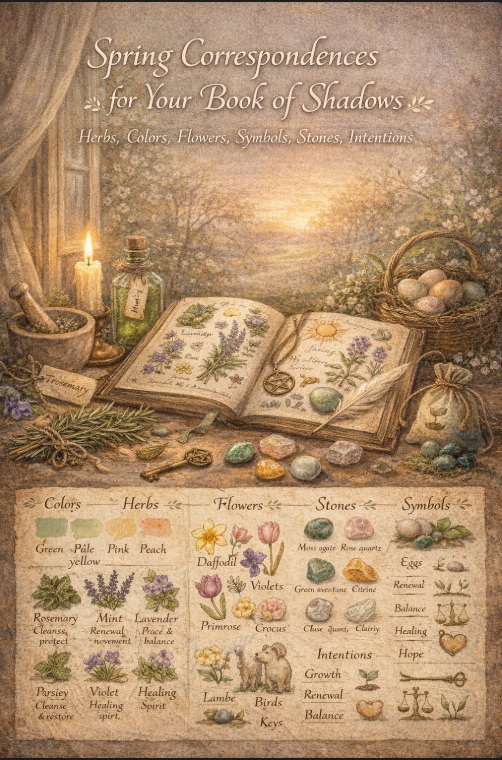
Spring Correspondences for Your Book of Shadows Herbs, colors, flowers, symbols, stones, and intentions for the season of renewal
Spring has a way of arriving in layers. First there is the shift in the light. Then the softening of the air. Then the first green things begin to appear, sometimes so quietly you almost miss them. It is a season of return, but not in a loud or hurried way. Spring does not burst in all at once. It wakes slowly, and in that slow waking there is a kind of magick all its own.
For many witches and spiritual practitioners, spring is a season of renewal, growth, fresh starts, balance, fertility, and hope. It is a beautiful time to refresh your altar, update your Book of Shadows, and gather the correspondences that feel true to this part of the year. Some of these are traditional, some are intuitive, and some may be deeply personal. That is part of the beauty of keeping a Book of Shadows in the first place. It becomes a living record of how the seasons speak to you.
Below is a simple but meaningful collection of spring correspondences you can use in your own practice, journaling, altar work, spellcraft, seasonal decorating, or quiet reflection.
The energy of spring
Before getting into the lists, it helps to pause and name the feeling of the season.
Spring carries the energy of:
awakening
renewal
fresh starts
fertility
hope
growth
balance
healing
movement
possibility
This is not quite the full abundance of summer. Spring is the first stirring. The first sign of life returning. The first little yes after a long no.
If winter is the inward season, spring is the season of emergence.
Spring colors
Color correspondences can be used in candles, altar cloths, ribbons, flowers, clothing, journal pages, spell bags, and seasonal decorations. Spring colors often reflect both the soft return of life and the brighter promise of what is to come.
Some traditional and intuitive spring colors include:
Green Growth, fertility, healing, abundance, renewal, new life
Gold The returning sun, vitality, blessing, sacred illumination
You do not need to use all of these. Even one or two colors can be enough to shift the feeling of a space and align your work with the season.
Spring herbs
Spring herbs tend to carry cleansing, protective, healing, and awakening qualities. Some are culinary, some are magickal, and many are both. Herbs can be used fresh or dried depending on your preference and availability.
Rosemary A wonderful herb for cleansing, remembrance, clarity, protection, and mental freshness. Rosemary is excellent in spring washes, bundles, altar bowls, and simple home blessings.
Mint Fresh energy, prosperity, movement, renewal, cooling, and clearing stagnant conditions. Mint feels like spring in herb form.
Lavender Peace, rest, beauty, emotional healing, gentle spiritual work, balance. Lavender is lovely for softening the nervous system after winter heaviness.
Thyme Courage, purification, vitality, strength, and resilience. Thyme has an old-world feel that sits beautifully in spring correspondences.
Basil Luck, abundance, prosperity, blessing, love, and freshness. Basil is one of those herbs that brings a lively, clean energy.
Parsley Renewal, cleansing, purification, protection, and health. Simple, common, and underrated.
Lemon balm Joy, ease, emotional soothing, uplift, restoration. Beautiful for spring after a difficult winter season.
Nettle Protection, strength, vitality, and healing. Nettle carries a wilder edge and reminds us that spring is not only delicate. It is powerful too.
Dill Luck, prosperity, protection, and growth. Dill carries a bright, living energy.
Sage Wisdom, purification, blessing, and spiritual clearing. If you use sage in your practice, spring is a natural time to work with it intentionally.
You might also choose herbs based on what is growing near you. Local plants often make the strongest seasonal allies.
Spring flowers
Flowers are one of the most obvious symbols of spring, but they also carry distinct energies. They can be placed on an altar, pressed into journals, woven into seasonal wreaths, offered to spirits, or simply enjoyed as living reminders of the season.
Daffodil Hope, rebirth, cheerful energy, return of life, confidence
Rose Love, beauty, blessing, sensuality, and spiritual devotion. Roses can belong to many seasons, but soft pink or white roses can fit beautifully into spring work.
Even if you do not have access to fresh flowers, images, pressed petals, or simple floral sketches in your Book of Shadows can hold the same feeling.
Spring stones and crystals
Crystals for spring often support growth, emotional clarity, healing, new beginnings, and balance. Choose the ones that feel alive in your hand. Spring is a tactile season. It wants to be felt.
Moss agate Growth, new beginnings, earth connection, stability, abundance. One of the best spring stones.
Green aventurine Luck, opportunity, prosperity, optimism, expansion
Rose quartz Self-love, tenderness, heart healing, emotional renewal
You do not need a large crystal collection to work seasonally. One stone placed on your altar, carried in your pocket, or tucked into a journal can be enough.
Spring symbols
Symbols are often the fastest way to create a seasonal feeling in your Book of Shadows. They can be drawn, painted, collaged, stitched, or simply noted as anchors for later use.
Some common spring symbols include:
eggs
nests
seeds
buds
sprouts
hares or rabbits
lambs
birds
feathers
bees
butterflies
Not every spring symbol has to be sweet or decorative. Spring is also mud, wind, unpredictability, cold mornings, and hard little shoots pushing through frozen ground. That belongs to the season too.
Spring intentions
One of the most useful parts of a seasonal correspondences page is the intentions section. This tells you what kind of work the season naturally supports.
Spring intentions may include:
renewal
balance
healing
hope
fertility
growth
new beginnings
prosperity
fresh energy
emotional clearing
inspiration
confidence
This is a very good season for spells and rituals around:
starting over
finding your footing again
clearing out old heaviness
blessing a new home or project
planting prosperity
encouraging love and beauty
supporting healing and hope
inviting life back into a stagnant situation
It is also a season for simple personal promises. Not grand vows. Just the kind that help you move with the light.
Ways to use these correspondences
Once you gather your spring correspondences, you can put them to work in simple, beautiful ways.
You might:
create a dedicated spring page in your Book of Shadows
make a seasonal altar with one flower, one herb, one stone, and one candle
choose a spring color palette for journaling or decorating
build a small charm bag for renewal or growth
write a spring prayer using the symbols that speak to you
refresh your home with herbs and open windows
press spring flowers into your journal
create a list of what you want to grow this season
pair a spring stone with a seasonal intention and carry it with you
This does not have to be complicated to be meaningful.
A gentle note on personal correspondences
One of the most important things to remember is that correspondences are guides, not rules.
If spring feels pale gold to one person and stormy silver to another, both can be true. If violets mean comfort to you because of a childhood memory, that matters. If rosemary always reminds you of your grandmother’s kitchen, that matters too. A living spiritual practice makes room for that kind of truth.
Your Book of Shadows should not just be a record of what other people say spring means. It should also become a record of what spring means to you.
What herbs do you reach for when the weather changes? What colors feel like return? What flowers stop you in your tracks? What kind of hope begins to stir in you when the light comes back?
Those are correspondences too.
Closing thoughts
Spring is a season of becoming. Not fully arrived, not fully formed, not yet in bloom, but moving unmistakably in that direction. There is something deeply sacred about that stage. The tenderness of it. The uncertainty of it. The quiet determination of it.
When you add spring correspondences to your Book of Shadows, you are doing more than making a list. You are creating a doorway into the season. A way to remember what this time of year feels like in your body, your home, your spirit, and your practice.
Use what speaks to you. Keep what feels alive. Let the season meet you where you are.
The earth does not rush into bloom, and neither do you need to.
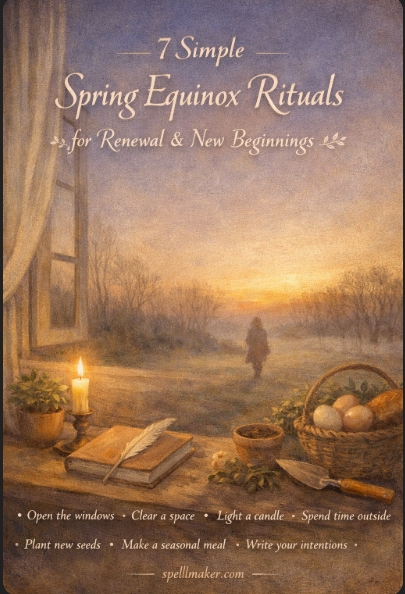
7 Simple Spring Equinox Rituals for Renewal and New Beginnings
The Spring Equinox is one of those quiet turning points in the year that you can almost feel before you can explain it. The light lingers a little longer in the evening. The air shifts. The earth begins to stir. Even if the trees are still mostly bare and the mornings still carry a chill, something has changed.
This is the balance point of the season, the moment when day and night stand equal. From here, the light begins to grow. For many people, the Spring Equinox feels like a natural time to reset, clear space, and welcome fresh energy into both home and spirit.
The nice thing about honoring the equinox is that it does not have to be complicated. You do not need an elaborate ritual, a perfectly decorated altar, or a long list of supplies. Often, the simplest acts are the ones that carry the most meaning.
If you have been feeling tired, stuck, or ready for a fresh start, here are seven simple ways to honor the Spring Equinox and welcome renewal into your life.
1. Open the windows and let in fresh air
One of the easiest and most satisfying equinox rituals is simply opening the windows and letting the house breathe.
After a long winter, our homes can start to feel heavy. The air gets stale, the rooms feel closed in, and everything begins to hold the energy of the colder months. Opening the windows, even for a short time, is a way of inviting in movement, freshness, and change.
You might do this while saying a quiet prayer, setting an intention, or simply standing still for a moment and letting the new air move through the room. It is a small act, but it can shift the feeling of a space almost immediately.
2. Clear one small space
The Spring Equinox is a wonderful time for clearing, but that does not mean you need to tackle the whole house in one day.
Choose one small area instead. A tabletop, a nightstand, a drawer, an altar, or even just one corner of a room. Wipe it down. Remove what does not belong. Make it feel lighter and more open than it did before.
This kind of clearing is about more than tidying up. It is about making room. When we clear physical space, we often create emotional and spiritual space too. We send a quiet message to ourselves that we are ready for something new to enter.
3. Light a candle for balance and new beginnings
A candle is a beautiful way to mark the equinox because this sabbat is so deeply tied to the return of the light.
You might choose a white candle for clarity and balance, a yellow candle for joy and fresh energy, or a green candle for growth and renewal. Keep it simple. There is no need to overthink it.
As you light it, take a moment to reflect on what you are leaving behind and what you hope to welcome in. You can sit quietly with the flame, say a few heartfelt words, or just let the candle burn while you move through the rest of your evening.
Sometimes the smallest rituals are the ones that stay with us the longest.
4. Spend a little time outside
The equinox is a reminder that the earth is waking up, and one of the best ways to honor that is to step outside and notice it.
You do not need a grand nature outing. Stand in the yard. Sit on the porch. Take a short walk. Look closely at the trees, the grass, the sky, and the way the light falls. Listen for birds. Notice what is beginning to return.
This ritual is especially powerful because it asks nothing from you except attention. No performance. No pressure. Just presence.
If you feel comfortable doing so, you might place your hand on a tree, stand with your face turned toward the sun, or offer a quiet word of thanks for the season ahead.
5. Plant seeds or begin something small
Spring is the season of beginnings, so the equinox is a natural time to plant something, literally or symbolically.
If you enjoy gardening, plant seeds in the soil or start something small indoors. If gardening is not your thing, think about what else you would like to begin. A new habit. A creative project. A journal. A prayer practice. A goal that feels ready now, even if it did not a few months ago.
The key here is to start small. Early spring is not the full bloom. It is the first stirrings of life. This is not the time to overwhelm yourself with a hundred plans. It is the time to gently begin.
Ask yourself: what do I want to grow this season?
That question alone can be a ritual.
6. Make a simple seasonal meal
Food has always been one of the most grounding ways to mark the turning of the year.
A Spring Equinox meal does not have to be fancy. It can be as simple as fresh bread, eggs, greens, herbs, honey, or something light and nourishing that feels like a welcome shift from the heavier foods of winter.
The point is not perfection. The point is mindfulness. Prepare it with care. Set the table if you can. Light a candle. Eat slowly. Let the meal become a way of noticing the season and receiving it.
There is something deeply sacred about feeding yourself with intention.
7. Write down what you want to grow this season
This may be the simplest equinox ritual of all, but it is also one of the most powerful.
Take a few minutes to write down what you want to grow in the months ahead. Not just what you want to accomplish, but what you want to nurture. Peace. Confidence. Better health. Creativity. Stability. Love. A stronger sense of purpose. A new project. A softer inner life.
Try not to make it a giant list. Keep it honest. Keep it personal. Choose what feels real.
You can tuck your words into a journal, place them beneath a candle, or keep them on your altar as a reminder of what you are calling forward.
The Spring Equinox is not about having everything figured out. It is about recognizing that the season has turned, the light is returning, and something in you is ready to begin again.
That is enough.
However you choose to honor the equinox, let it be simple. Let it be real. Let it meet you where you are.
You do not need to do everything. One candle, one open window, one cleared corner, one quiet intention can be enough to mark the moment.
The earth is not rushing, and you do not have to rush either.
Stand in the balance. Breathe in the new season. And take one small step toward what you want to grow.
The Spring Equinox arrives without fanfare, but you feel it.
Not in the loud way of holidays or the dramatic sweep of a full moon, but in something softer. The light lingers just a little longer in the evening. The air shifts. The world feels like it’s taking a slow, steady breath after a long winter.
This is the moment of balance.
Day and night stand equal, neither one holding more power than the other. It’s a rare kind of still point in the year—a quiet pause where things aren’t pushing forward or pulling back, just… resting in between. And there’s something deeply comforting about that.
We spend so much time trying to move ahead, to fix things, to grow faster, to figure it all out. The equinox reminds us that there is value in standing still for a moment and simply noticing where we are.
What has changed?
What has softened?
What is ready to begin again?
Early spring doesn’t come in full bloom. It comes in hints. A little green pushing through the soil. Trees that are still bare but no longer feel lifeless. The faint warmth of the sun that feels almost unfamiliar on your skin.
It’s subtle, but it’s undeniable.
And that’s how real change often works too.
Not in grand, sweeping transformations, but in small shifts that you might miss if you aren’t paying attention. A thought that feels a little lighter. A situation that doesn’t weigh on you the way it used to. A quiet sense that something is opening, even if you can’t fully see it yet.
The Spring Equinox is not about sudden blooming. It’s about awakening.
It’s about the moment when the earth begins to stir again, when life starts to return—not loudly, but steadily. There’s a patience to it. A knowing that growth doesn’t need to be rushed.
This is a beautiful time to check in with yourself in a gentle, honest way.
Not with pressure. Not with a list of things you think you should be doing.
Just a quiet question:
What feels ready?
Maybe it’s something small. A habit you’ve been meaning to return to. A space in your home that wants clearing. A creative idea that has been sitting quietly in the background, waiting for your attention.
Maybe it’s something deeper. A part of yourself that you’ve been protecting or putting off, now asking to be seen again.
You don’t have to do everything at once. The earth isn’t rushing, and neither do you need to.
Even the act of clearing space—physically or emotionally—is part of the work of the equinox. Opening a window. Letting in fresh air. Wiping down a table. Making room for something new without forcing it to arrive.
There’s power in that.
In many traditions, the Spring Equinox is associated with renewal, fertility, and the return of life. But underneath all of that is something simpler and more personal: the permission to begin again.
Not because you failed. Not because you’re behind.
But because the timing is right.
The balance of light and dark also asks us to look at ourselves with a little more honesty. Both sides are present. The parts of us that are growing, and the parts that still feel heavy or uncertain.
And that’s okay.
You don’t need to be “all light” to move forward. You just need to be willing to stand in that balance and keep going.
There’s a quiet kind of strength in that kind of acceptance.
As the day and night stand equal, you’re invited to find your own center point. To notice what feels steady, what feels aligned, what feels like truth underneath all the noise.
From there, growth becomes a little easier. A little more natural.
You don’t have to force it.
You just have to allow it.
The energy of the equinox isn’t loud or demanding. It doesn’t push you into action. Instead, it gently opens the door and lets the light in, a little at a time.
And sometimes, that’s exactly what we need.
So as this season turns, take a moment to pause and notice the shift—both around you and within you.
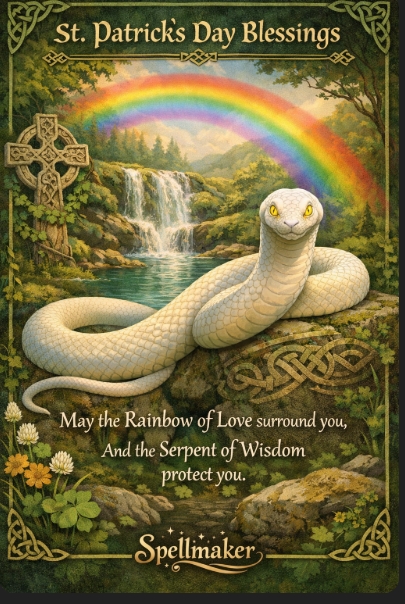
Every year on March 17, the world turns green. People gather for parades, Irish music, good food, and a toast or two in honor of St. Patrick, the patron saint of Ireland. Shamrocks appear everywhere, stories of saints and serpents are told, and the day takes on that cheerful, celebratory feeling that comes with the first hints of spring.
But St. Patrick is not the only holy figure connected with March 17.
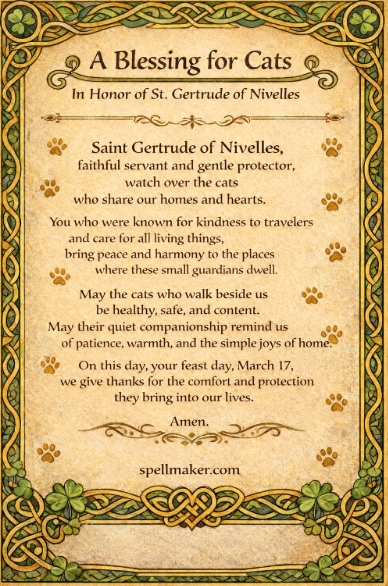
The same day is also the feast day of St. Gertrude of Nivelles, a lesser-known saint from the early Middle Ages who has quietly earned a reputation among animal lovers as the unofficial patron saint of cats.
While the Vatican has never formally declared her the patron saint of felines, folklore, history, and a good deal of medieval artwork have firmly connected her with our whiskered companions.
And once you hear the story, it makes a surprising amount of sense.
St. Gertrude was born in the year 626 in the town of Nivelles, in what is now modern-day Belgium. She came from a wealthy and influential family during the Merovingian period of European history. Even as a child, Gertrude showed a strong desire for religious life.
This led to a dramatic moment when she was only about ten years old.
At a banquet held by her father, a nobleman asked that Gertrude be promised in marriage to the son of a duke. Such arrangements were common among noble families at the time, often made to strengthen alliances and social standing.
But Gertrude shocked everyone present by firmly refusing.
She declared that she would marry no earthly man and that Christ would be her bridegroom. It was an unusually bold statement for a young girl in the seventh century, but it set the course for the rest of her life.
A few years later, Gertrude’s mother founded a monastery at Nivelles. Interestingly, it was a double monastery, meaning it housed both monks and nuns, something that was not unheard of in early medieval Europe but still relatively rare.
After her mother’s death, Gertrude eventually became the abbess of the community.
She was known for her deep devotion to prayer, her learning, and her hospitality toward travelers and pilgrims who passed through the region. In an era when long journeys were dangerous and difficult, monasteries often served as places of refuge. Gertrude welcomed visitors generously, and over time she became known as a protector of travelers and pilgrims.
Her dedication to spiritual life, however, was intense.
Like many saints of the early church, she practiced strict asceticism. She fasted frequently, slept very little, and devoted long hours to prayer. These practices gradually weakened her health. By the time she was thirty-two years old, she had become too ill to continue serving as abbess and stepped down from the role.
She died not long afterward, on March 17 in the year 659, at the age of thirty-three.
Almost immediately after her death, people began honoring her as a saint. Stories circulated of miracles attributed to her prayers and protection. She was said to have saved her monastery from fire, restored sight to the blind, revived a drowned child, and protected travelers in dangerous situations.
One medieval legend even tells of sailors who prayed to St. Gertrude during a storm at sea when a giant sea creature rose from the water and threatened their ship. After they called upon her for help, the creature vanished and the sailors reached shore safely.
Because of stories like this, medieval travelers sometimes toasted St. Gertrude before beginning a journey.
Over time, she became associated with a wide range of patronages, including pilgrims, gardeners, widows, and those suffering from illness or fever.
But the story of how she became linked to cats begins with something much smaller.
Mice.
In late medieval artwork, St. Gertrude often appears holding an abbess’s staff while mice run at her feet or climb along the crozier. At first glance it seems like a strange detail, but there are several explanations.
One theory comes from medieval symbolism. In parts of the Netherlands, mice were sometimes used to represent souls in Purgatory, the place where Catholics believed souls were purified before entering heaven. Because Gertrude was known for praying constantly for the souls of the departed, the mice may have symbolized the spirits she interceded for.
Another explanation is far more practical.
According to legend, the monastery at Nivelles once suffered from a serious mouse infestation that threatened their grain stores. Gertrude prayed for relief, and the mice disappeared. After her death, people began invoking her protection against rats and mice, which were major threats to food supplies in medieval communities.
And where there are mice, there are usually cats.
Monasteries across Europe commonly kept cats to protect grain stores, manuscripts, and kitchens from rodents. Cats were valued working animals, quiet guardians of the pantry and library.
So if St. Gertrude protected homes and monasteries from mice, it was only natural that her reputation would extend to the animals who helped control them.
By the late Middle Ages, the connection between St. Gertrude and cats had become firmly rooted in folklore.
In modern times, the idea gained renewed attention when a 1981 publication from the Metropolitan Museum of Art referred to St. Gertrude of Nivelles as the patron saint of cats. The title quickly caught on, especially among cat lovers who were delighted to discover that their favorite animals had a saintly advocate.
Today, while her patronage of cats remains unofficial, St. Gertrude is widely celebrated as their gentle protector.
So the next time March 17 arrives and the world fills with shamrocks and St. Patrick’s Day celebrations, it may be worth remembering that another saint shares the day.
St. Gertrude of Nivelles, the quiet abbess of a seventh-century monastery, left behind a legacy of hospitality, prayer, and care for the small creatures who shared her world.
And for anyone who lives with a cat curled beside them on a chair, windowsill, or altar, that connection feels surprisingly fitting.
After all, homes guarded by cats have always had a certain kind of magic. 🐈🍀
Please print out and enjoy this prayer card for St. Gertrude! Hold it between your hands while praying, place it near a photo of your beloved feline or near their bed if they might be under the weather.
There are seasons when life feels suspended. Decisions are out of your hands. Money is in limbo. Calls are not returned. Plans feel fragile. You wake up already tense.
Uncertainty has weight.
Many people believe staying spiritually steady means feeling calm all the time. It doesn’t. Faith is not the absence of fear. Magick is not control.
Staying spiritually steady during uncertainty means you don’t let fear run your life.
If you are walking through a stressful or uncertain season, here are a few steadying practices that truly help.
Narrow the Horizon
When life feels unstable, your mind jumps months ahead. Mortgage. Job. Health. Relationships. Worst-case scenarios stack up fast.
Pull it back.
Ask yourself one question: What needs my attention today?
Not next month. Not the entire future. Just today.
Spiritual steadiness often begins by refusing to catastrophize beyond the current sunrise.
Create One Daily Anchoring Ritual
When everything feels unpredictable, choose one small ritual that belongs to you.
Light a white candle each morning. Drink peppermint tea before bed. Step outside for five quiet minutes and breathe.
One action. Every day.
Consistency tells your nervous system that something in your world is still stable. That matters more than you think.
Protect Your Peace During Stressful Seasons
If you are already carrying uncertainty, do not add extra noise.
Limit doom scrolling. Step away from unnecessary arguments. Be mindful of who and what you allow into your mental space.
Peace does not just happen. It is protected.
Ground Yourself in the Physical World
When your thoughts begin spiraling, shift into your body.
Wash dishes. Brush your dog. Chop vegetables. Sweep the porch. Fold laundry.
Spirit lives in ordinary tasks. Stability is built through small, physical acts of care.
Uncertainty Is Not a Verdict
Not having answers yet does not mean the outcome is bad.
It means it is still unfolding.
There is a difference.
You can feel afraid and still be faithful. You can feel tired and still be steady. You can feel unsure and still remain grounded.
That is real strength.
If you are in a season of financial stress, relationship uncertainty, or simply waiting for answers, you are not failing spiritually. You are living through a chapter that requires endurance.
And if you would like personal guidance, candle suggestions, or support for your specific situation, you can write to mycase@spellmaker.com. We are here to help you stay spiritually steady while life rearranges itself.
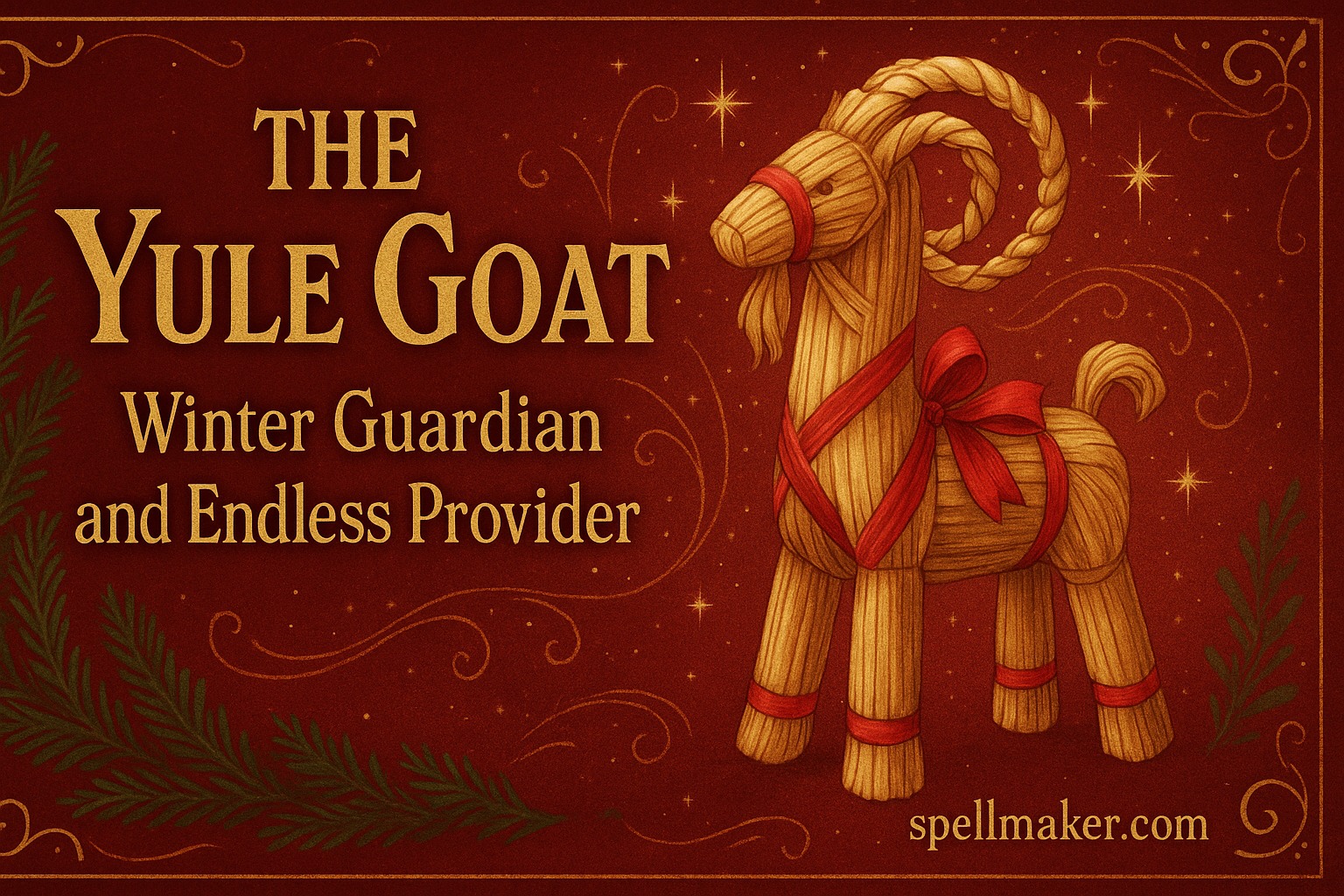
Every winter, I see those little straw goats tied with red ribbon popping up in photos, craft shops, and holiday displays. Most people think they’re just a cute Scandinavian tradition — and they are cute — but the Yule Goat is so much more than a decoration. Behind that bundle of straw is an ancient protector whose story carries themes of strength, renewal, and prosperity that echo beautifully across cultures, including our own work with the lwa.
If you’ve never heard of the Yule Goat, you’re not alone. He’s well-known in northern Europe but not often talked about in Voodoo circles. And yet… once you hear his story, you’ll see why this winter guardian fits right into the spiritual language of protection and provision.
Where the Yule Goat Came From
The Yule Goat’s story stretches deep into pre-Christian Scandinavia. Long before reindeer and sleigh bells, midwinter celebrations centered on survival — keeping the home safe, protecting the harvest, and calling back the returning light.
One of the oldest winter customs involved saving the last sheaf of grain from the harvest and crafting it into a goat. This goat became the household guardian for the dark half of the year, carrying blessings of protection, good fortune, and strength.
As centuries passed, the Yule Goat absorbed more layers of meaning. People dressed up as goats during Yule, knocking on doors to test hospitality, offer blessings, or chase away lingering negativity from the old year. And woven into all of this was the thunder god Thor — whose chariot raced across the winter sky, pulled by two mighty goats.
So yes… a straw goat is doing a lot more than sitting on a shelf.
Thor’s Goats and the Promise of Endless Provision
Thor’s goats — Tanngrisnir (“Teeth-Barer”) and Tanngnjóstr (“Teeth-Grinder”) — weren’t ordinary animals. They were symbols of power, sustenance, and miraculous renewal.
Each night, Thor could slaughter and cook the goats to feed himself and anyone traveling with him. And each morning, as long as their bones were laid together unbroken, the goats regenerated — whole, strong, alive, and ready to pull his chariot again.
It’s a breathtaking symbol when you sit with it:
You will always be provided for. What nourishes you will return. Blessings renew themselves. Prosperity is a cycle, not a one-time gift.
It’s winter survival woven into mythic form — a miracle of provision at the darkest time of year.
Where Sobo Steps Into the Story
Here’s where this gets especially meaningful for those of us who work within the Voodoo tradition.
Sobo, the lwa of thunder, strength, clarity, and rightful power, is frequently depicted in imagery reminiscent of Thor — riding in a chariot with goats or rams leading the way, lightning illuminating the sky around him. This is not syncretism; it’s a recognition of universal symbolism. Thunder spirits across cultures share the same roles: protectors, road-openers, bringers of nourishment and stability.
Just like Thor, Sobo clears obstacles, fortifies your path, strengthens your will, and brings material support when it’s needed most. His presence is grounding, bright, and deeply stabilizing.
When you look at the Yule Goat through this lens — a guardian woven from the harvest, tied to thunder, and rooted in renewal — it harmonizes beautifully with Sobo’s energy.
Both traditions carry teachings of protection through the long nights, strength in the face of darkness, cycles of nourishment and return, and prosperity that regenerates itself. The symbols are different, the cultures are different, but the spiritual heartbeat is the same.
Why the Yule Goat Belongs in a Voodoo Home
Setting out a Yule Goat this winter isn’t just adopting a Scandinavian custom — it’s inviting in a symbol that speaks to Sobo’s own sacred qualities.
He becomes a cross-cultural winter guardian: standing at your hearth, carrying the memory of ancient thunder, promising renewed strength, and reminding you that provision is ongoing.
The Yule Goat says: “You are protected. You have enough. More is coming. Blessings return.” That is Sobo’s voice too.
A Simple Yule Blessing to Honor Both Traditions
If you’d like to weave these energies together, try this small act:
Place a Yule Goat near your altar or front doorway. Light a white or golden candle beside it. Say:
“Strength before me, strength behind me. Provision above me, provision beneath me. Let what I need return renewed.”
Then give thanks to Sobo for his clarity, protection, and thunder-bright power.
One thing I love about this time of year is that it is so full of fun and interesting lore! And Krampus lore just happens to make my German ancestors very happy!
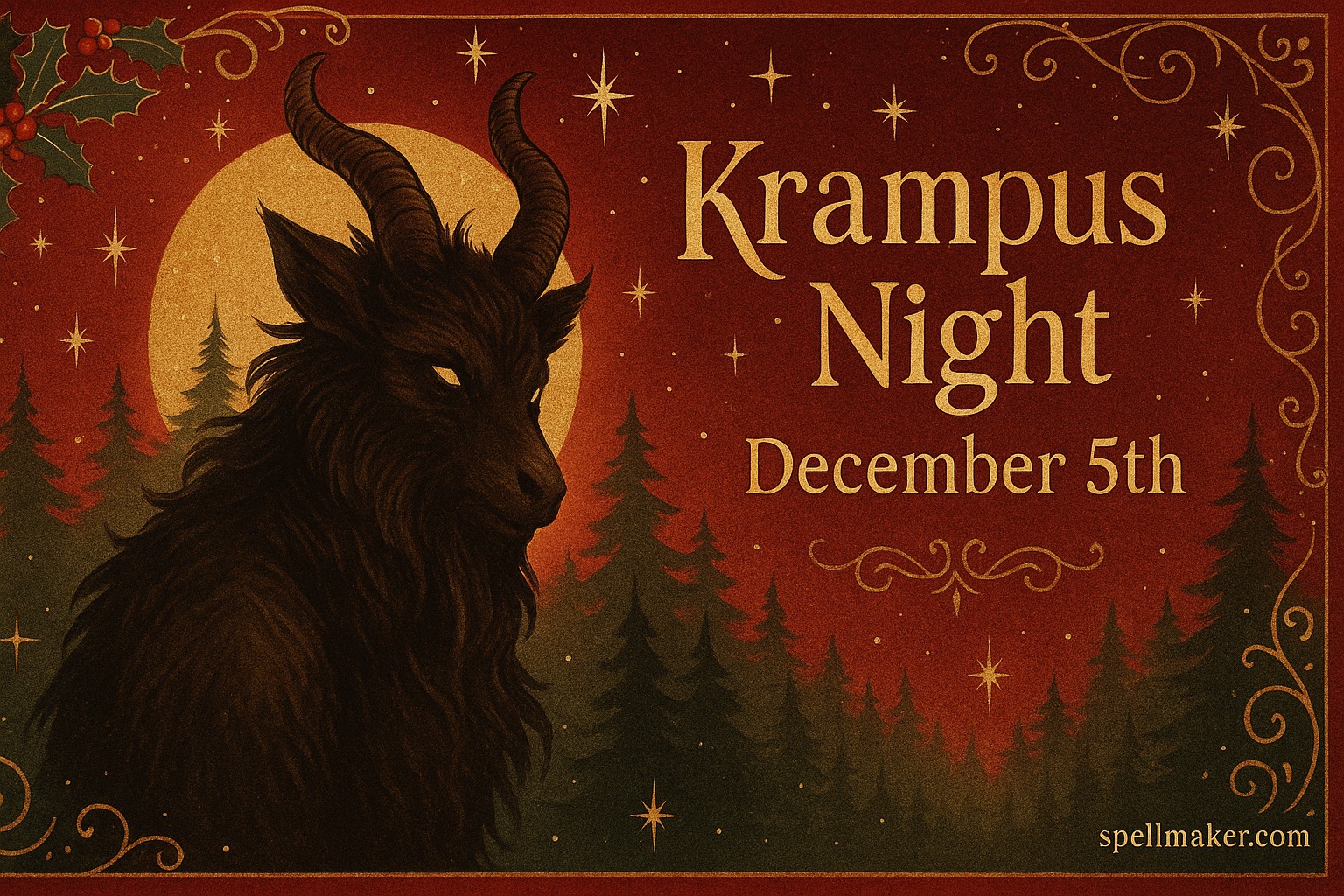
Krampus Night arrives on December 5th, the eve of St. Nicholas Day, and with it comes one of winter’s most fascinating old-world spirits. In Alpine folklore, Krampus is the horned, wild, winter creature who travels ahead of St. Nicholas — not as an enemy, but as his necessary counterpart.
Where St. Nicholas rewards goodness, Krampus handles the rest.
In the oldest stories, the two travel together from house to house. St. Nicholas brings gifts, blessings, and encouragement. Krampus comes first, rattling his chains, ringing bells, and sweeping through the house to clear away mischief, bad behavior, and energies that don’t belong. He is the “shadow” of the season — not evil, but the one who enforces boundaries so the blessings of St. Nick have a clean path forward.
Krampus’s role in the legend is simple:
He removes what must go, so the gifts of the season can arrive.
This is why he comes on December 5th, while St. Nicholas comes on December 6th. Krampus prepares the way. He is the winter’s broom, making sure negativity is handled before goodness enters the home.
In some traditions, Krampus carried a switch or birch branch — not to harm, but as a symbol of discipline, transformation, and clearing. He also carried a basket on his back to “take away” the worst behaviors or energies of the previous year. In modern spiritual terms, he is the spirit of banishment, boundaries, and necessary removal.
When we look at him through a magical lens, Krampus becomes incredibly useful:
• Clearing away stagnant or harmful energy • Banishing what oversteps your boundaries • Removing energy-drainers and chaos • Breaking patterns you no longer wish to repeat • Preparing the home for winter blessings and protection
Krampus energy pairs perfectly with the early December season: the time when darkness is deepest, and we begin to consciously sweep out what has piled up emotionally, mentally, and spiritually.
A simple Krampus Night ritual:
Write down something you refuse to carry into the new year — a habit, a fear, a toxic connection, or even a feeling that’s overstayed its welcome. Fold the paper away from you three times. Say: “Krampus, keeper of winter’s truth, Take this burden from my path.” Then burn it safely or toss it away outside.
Krampus isn’t a monster. He’s the reminder that every blessing has a shield, every light has a shadow, and every home deserves to be protected before the gifts of the season arrive.
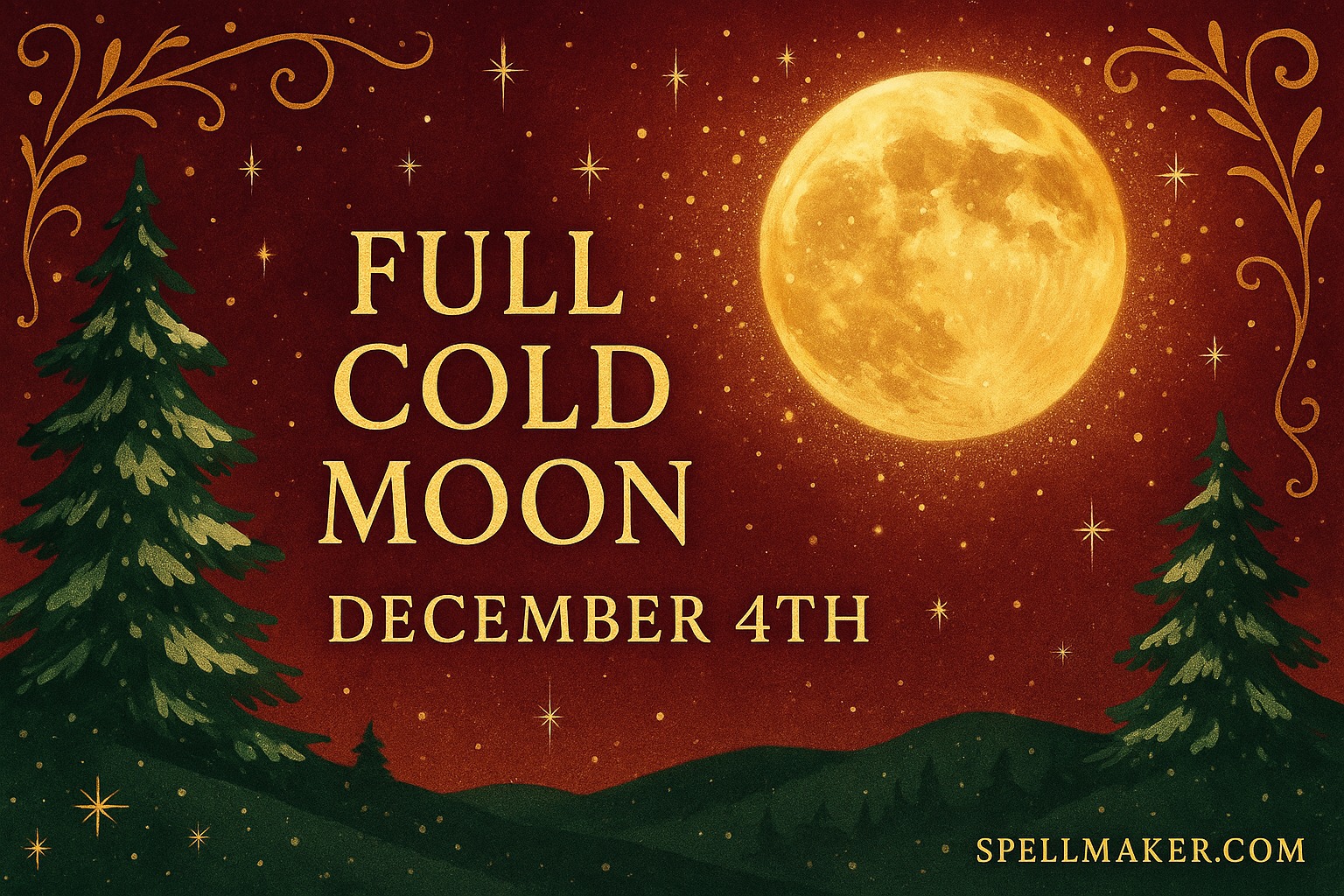
The Full Cold Moon rises on December 4th, bringing with it a moment of clarity in the deep quiet of early winter. This moon is a bright lantern in the dark—showing you what’s truly important, what’s worth holding onto, and what can finally be put down.
The Cold Moon asks us to slow our breathing, pull our energy closer, and listen to what our spirit has been whispering beneath all the noise. It’s a powerful time for restoration, truth-seeking, and strengthening your inner boundaries.
Spiritually, this moon is wonderful for:
• Clearing out emotional heaviness • Reconnecting with your ancestors and guides • Protection and grounding spells • Visioning the winter months ahead • Reaffirming your sense of purpose
If you’re feeling tired, stretched thin, or uncertain, this moon is here to steady you. Its energy has a quiet confidence—gentle enough to comfort, strong enough to illuminate the path forward.
A simple way to work with the Full Cold Moon tonight:
Hold a candle (white, blue, or silver) and speak:
“Cold Moon, clear my mind. Steady my heart. Strengthen my spirit. Guide my next step.”
Let the light remind you that even in the darkest season, you are never without direction.